Fritz Haber
German chemist and receiver of the Nobel prize (1868-1934) · Germany · Scientists · Died at 65
Fritz Haber is read about 1,600 times a day, in 86 languages.
A typical day, 30 days to 15 October 2026
The middle day of the days counted, so one week of news cannot move it. The line under it is the last 390 days, one point a day.
Something wrong?The chemist who fed billions and invented chemical weapons: his process for synthesizing ammonia sustains nearly half the world's population through fertilizer, and his chlorine-gas warfare broke the trenches at Ypres.
A life in dates
Also in Deutsch
Photos 8
%2C_SFA002023057.jpg?width=1200) Portret van Professor Fritz Haber, een chemicus uit Duitsland (foto 1918- 1934), SFA002023057
Portret van Professor Fritz Haber, een chemicus uit Duitsland (foto 1918- 1934), SFA002023057_4e_centenaire_du_Coll%C3%A8ge_de_France%2C_M._Habert_(i.e._Fritz_Haber)_professeur_(et_chimiste)_allemand_-_btv1b532459936.jpg?width=1200) (18-6-31) 4e centenaire du Collège de France, M. Habert (i.e. Fritz Haber) professeur (et chimiste) allemand - btv1b532459936
(18-6-31) 4e centenaire du Collège de France, M. Habert (i.e. Fritz Haber) professeur (et chimiste) allemand - btv1b532459936 Fritz Haber 1891 Prom
 Bundesarchiv Bild 183-S13651, Fritz Haber
 Fritz Haber 1906 Karlsruhe
 1911 Nachbau der Versuchsanordnung Fritz Habers zur Ammoniaksynthese
 Haber Ammonia
 KWI f Chemie einweihung
Awards
Family

 Fritz Haber
Partners

Children
Is this everyone?
Only relatives with a profile here are drawn, so a family can be larger than this. A line here can also be wrong.
Correct this familyAbout this person
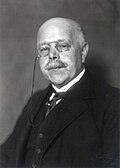
Fritz Jakob Haber, born 9 December 1868, was a German chemist whose invention of the Haber process - synthesizing ammonia from nitrogen and hydrogen - won him the 1918 Nobel Prize in Chemistry and now supports roughly a third of global food production. A known German nationalist, he turned his mind to war during World War I, pioneering chlorine gas as a weapon to break trench deadlock at the Second Battle of Ypres, earning him the title "father of chemical warfare." His work was later adapted, without his involvement, into Zyklon B, the pesticide used to kill over a million Jews in Holocaust gas chambers. After the Nazis rose to power in 1933, Haber resigned and accepted an offer from Chaim Weizmann to lead the Sieff Research Institute in Mandatory Palestine, but he died of heart failure in a Basel hotel on 29 January 1934, aged 65, never reaching his destination.
In common with Fritz


Scientists from Germany 3


Fame.am measures public visibility signals. It does not measure human value, talent, morality, or credibility.