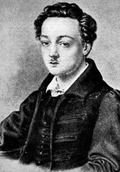
Friedrich Schlegel
German poet, critic and scholar, editor · Germany · Writers · Lived 1772 to 1829 · aged 56
Friedrich Schlegel is read about 247 times a day, in 55 languages.
A typical day, 30 days to 15 October 2026
The middle day of the days counted, so one week of news cannot move it. The line under it is the last 390 days, one point a day.
Something wrong?The critic who helped invent Romanticism, then turned his back on everything it stood for. Schlegel moved from atheism to Catholic conversion, from literary journals to serving Metternich's Austria - losing friends and family along the way.
Also in Deutsch
Photos 8


In their own words 10
 ,
In England … everything becomes professional … even the rogues of that island are pedants.
Poetry can be criticized only through poetry.
Irony is the form of paradox. Paradox is what is good and great at the same time.
Awards
Family
Parents
 Friedrich Schlegel
Partners


Is this everyone?
Only relatives with a profile here are drawn, so a family can be larger than this. A line here can also be wrong.
Correct this familyAbout this person
Born into a Protestant household in 1772, Schlegel ditched law school for classical literature and spent his twenties as an atheist critic building the Romantic movement alongside his brother August Wilhelm. He founded journals like Athenaeum and shaped the era's literary consciousness, influencing Coleridge and later Polish Romantics. In 1808, married, he converted to Catholicism - a choice that severed ties with the circle that had defined him. A year later he moved to Austria and became a diplomat and journalist under Metternich, the Foreign Minister. He also pioneered Indo-European linguistics, spotting what would be called Grimm's law and publishing the first theory linking Indo-Iranian and German languages in 1819. He died in 1829 at fifty-six, his late work set to music by Schubert, Mendelssohn, and Schumann.




Fame.am measures public visibility signals. It does not measure human value, talent, morality, or credibility.