Friedrich Hayek
Austrian and British economist (1899-1992) · Austria · Academics · Died at 92 · also United Kingdom
Friedrich Hayek is read about 1,887 times a day, in 84 languages.
A typical day, 30 days to 15 October 2026
The middle day of the days counted, so one week of news cannot move it. The line under it is the last 390 days, one point a day.
Something wrong?He won a Nobel for showing how prices think - aggregating scattered knowledge across millions of strangers without anyone being in charge. That insight made Hayek the intellectual architect of free-market arguments in the late 20th century, and The Road to Serfdom the handbook.
A life in dates
Also in Deutsch
Photos 8
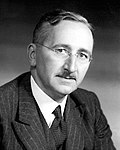
 Friedrich Hayek portrait
 01 Universität Wien Aula NobelpreistraegerInnen derknopfdruecker com
 1978 Medizin 26. Juni bis 30. Juni; Vor der Eröffnung- Feodor Lynen, Severo Ochoa, Charles B. Huggins, Ragnar A. Granit, Friedrich A. v. Hayek - LABW - Staatsarchiv Freiburg W 134 Nr. 111201r
 30. Tagung 1980 Chemiker; Studentenabend- am Tisch Friedrich A. v. Hayek, Frau v. Hayek, Manfred Eigen - LABW - Staatsarchiv Freiburg W 134 Nr. 117147a
 30. Tagung 1980 Chemiker; Studentenabend- am Tisch Friedrich A. v. Hayek, Frau v. Hayek, Manfred Eigen, Ernst O. Fischer in Rückansicht - LABW - Staatsarchiv Freiburg W 134 Nr. 117147b
 31. Tagung 1981 (29.6.-3.7.) Mediziner; Gruppen bei der Maikäferrede- Konrad Lorenz, Friedrich A. v. Hayek - LABW - Staatsarchiv Freiburg W 134 Nr. 118153c
 31. Tagung 1981 (29.6.-3.7.) Mediziner; Pressekonferenz- Friedrich A. v. Hayek mit Frau v. Hayek - LABW - Staatsarchiv Freiburg W 134 Nr. 118139
 32. Tagung 1982 Physiker; Eröffnung am 26.06.82- Friedrich A. v. Hayek - LABW - Staatsarchiv Freiburg W 134 Nr. 119132b
In their own words 10
 ,
I've always doubted that the socialists had a leg to stand on intellectually.
What is at issue is not union membership but compulsory union membership and not the right to strike but the right to compel others to strike.
Perhaps I'm unrealistic. As long as people do not fully realize the danger of inflation, they may well pressure for more inflation as a short-term remedy for evils.
Awards
Family
 Friedrich Hayek
Partners
Children
Is this everyone?
Only relatives with a profile here are drawn, so a family can be larger than this. A line here can also be wrong.
Correct this familyAbout this person
Friedrich August von Hayek fought in World War I as a teenager, and the wreckage pulled him toward economics - he wanted to understand what had gone so wrong. He earned doctorates in law and political studies in Vienna in the early 1920s, then moved through Austria, Britain, and the United States, teaching at the London School of Economics and the University of Chicago. In 1944 he published The Road to Serfdom, a warning about centralized planning that became his most widely read work and has stayed in print for eight decades. Thirty years later he shared the 1974 Nobel in economics with Gunnar Myrdal for his work on money, fluctuations, and the way economic and social phenomena knot together. He became a British citizen in 1938, received the Presidential Medal of Freedom in 1991, and spent his final years teaching in Salzburg and Freiburg. He died in 1992, having shaped the vocabulary of classical liberalism and market thought across the century.
In common with Friedrich
 John Forbes Nash Jr.Both received Prize in Economic Sciences in Memory of Alfred Nobel
 Amartya SenBoth received Prize in Economic Sciences in Memory of Alfred Nobel
 Milton FriedmanBoth received Prize in Economic Sciences in Memory of Alfred Nobel
 Paul SamuelsonBoth received Prize in Economic Sciences in Memory of Alfred Nobel
 Paul KrugmanBoth received Prize in Economic Sciences in Memory of Alfred Nobel
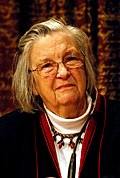 Elinor OstromBoth received Prize in Economic Sciences in Memory of Alfred Nobel
Fame.am measures public visibility signals. It does not measure human value, talent, morality, or credibility.