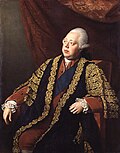
Frederick North, Lord North
✓ Source-basedstablePrime Minister of Great Britain from 1770 to 1782
The Prime Minister who held Britain together through the American Revolution - and took the blame when thirteen colonies walked away.
Also inDeutsch
Photos 5


.jpg?width=1200)
In their own words 4
Did freedom depend upon every individual subject being represented in that House? Certainly not; for that House, constituted as it was, represented the whole kingdom.
Speech in the House of Commons (16 June 1784), quoted in The Parliamentary Register: Or, History of the Proceedings and Debates of the
I was not, when I was honoured with office, a Minister of chance, or a creature of whom Parliament had no experience. I was found among you when I was so honoured.
Speech in the House of Commons (7 May 1783), quoted in The Parliamentary Register: Or, History of the Proceedings and Debates of the House
If you mean there should not be a Government by departments, Isigma with you; I think it a very bad system.
Remarks to Charles James Fox (14 February 1783), quoted in Memorials and Correspondence of Charles James Fox, Volume II, ed. Lord John
Awards 1
In their orbit 9




Politicians born in the 1730s 6




About this person
Frederick North became Prime Minister in 1770, a skilled administrator who managed the Treasury and commanded the House of Commons with ease. For twelve years he steered Britain through the American Revolutionary War, also serving as Home Secretary and Chancellor of the Exchequer. When the colonies won their independence in 1782, he resigned, and his reputation collapsed - 19th-century historians painted him as King George III's puppet, the incompetent who lost America. The 20th century offered a partial rehabilitation: he had been effective at finance, at Parliament, at defending the Church. But the charge stuck that his indolence, his failure to oversee the war effort as a whole, had let crisis slip through his fingers.
Fame.am measures public visibility signals. It does not measure human value, talent, morality, or credibility.