Enrico Fermi
Italian-American physicist (1901-1954) · Italy · Scientists · Died at 53 · also United States
Enrico Fermi is read about 2,120 times a day, in 150 languages.
A typical day, 30 days to 15 October 2026
The middle day of the days counted, so one week of news cannot move it. The line under it is the last 390 days, one point a day.
Something wrong?He built the first nuclear reactor in a squash court beneath the University of Chicago and stood in the New Mexico desert calculating the yield of the Trinity blast by dropping scraps of paper. Fermi worked both sides of physics - the equations and the hardware - and did both at the highest level.
A life in dates
Also in Deutsch
Photos 8
 Enrico Fermi 1943-49
 Ehrenfeststudents
 Solvay conference 1930
.jpg?width=1200) Nuclear Physics Congress, Rome (October 1931)
Nuclear Physics Congress, Rome (October 1931).jpg?width=1200) Physicists at the Seventh Solvay Physics Conference, Brussels, Belgium, October 1933 (4406390964)
Physicists at the Seventh Solvay Physics Conference, Brussels, Belgium, October 1933 (4406390964) Solvay1933Large
 Enrico Fermi and King of Sweden
 Atomic physicists Ernest O. Lawrence, Enrico Fermi, and Isidor Rabi - NARA - 558595
In their own words 5
 ,
, Such a weapon goes far beyond any military objective and enters the range of very great natural catastrophes.
I cannot think of a single one, not even intelligence.
I hope it won't take long.
Awards
In their orbit
 Spouse: Laura Fermi
About this person
Enrico Fermi made his name in statistical mechanics in the 1920s, applying Pauli's exclusion principle to ideal gases in what became Fermi-Dirac statistics; particles obeying that principle are now called fermions. He developed a theory of beta decay incorporating a particle he named the neutrino, describing what's now known as weak interaction, one of the four fundamental forces. His neutron experiments led him to discover that slow neutrons were more easily captured by nuclei, work for which he won the 1938 Nobel Prize - though what he thought were new elements turned out to be fission products. He left Italy that year as racial laws threatened his Jewish wife, Laura Capon, and joined the Manhattan Project in the United States. On 2 December 1942, his team at Chicago achieved the first self-sustaining nuclear chain reaction in Chicago Pile-1; he was present at Oak Ridge and Hanford when reactors went critical there, headed a division at Los Alamos working on Teller's hydrogen bomb, and witnessed Trinity on 16 July 1945. After the war he opposed the hydrogen bomb on moral and technical grounds and testified for Oppenheimer at the 1954 security hearing. An eleme
In common with Enrico
 Albert EinsteinBoth received Barnard Medal for Meritorious Service to Science
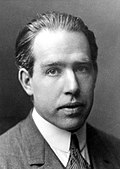 Niels BohrBoth received Matteucci Medal
 Max PlanckBoth received Max Planck Medal
 Ernest RutherfordBoth received Matteucci Medal
 Subrahmanyan ChandrasekharBoth received Henry Norris Russell Lectureship
 Thomas EdisonBoth received Matteucci Medal
Fame.am measures public visibility signals. It does not measure human value, talent, morality, or credibility.