Elinor Ostrom
American political economist (1933-2012) · United States · Academics · Died at 78
Elinor Ostrom is read about 567 times a day, in 81 languages.
A typical day, 30 days to 15 October 2026
The middle day of the days counted, so one week of news cannot move it. The line under it is the last 390 days, one point a day.
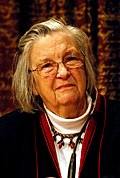
Something wrong?She proved that communities can manage shared resources - forests, fisheries, water - without collapsing into ruin or needing a government or corporation to step in. The work earned her the first economics Nobel given to a woman.
A life in dates
Also in Deutsch
Photos 8
 Nobel Prize 2009-Press Conference KVA-30
 A visit to Ostrom
 Elinor Ostrom - journal.pbio.1001405.g001 (cropped)
 Elinor Ostrom - journal.pbio.1001405.g001
 Elinor Ostrom close-up (cropped)
 Group Photo (4171912803)
 Nobel Laureate Elinor Ostrom (Economics) 2 (4171860780)
 Nobel Laureate Elinor Ostrom (Economics)
In their own words 2
 ,
Humans have a more complex motivational structure and more capability to solve social dilemmas than posited in earlier rational-choice theory.
We should continue to use simple models where they capture enough of the core underlying structure and incentives that they usefully predict outcomes.
Awards
In their orbit
About this person
Elinor Ostrom trained as a political scientist at UCLA and spent 47 years at Indiana University Bloomington, where in the 1960s she built the Workshop in Political Theory and Policy Analysis - a research center run like its name, collaborative and non-hierarchical, drawing scientists across disciplines. She spent decades studying how groups - communities, cooperatives, unions - interact with ecosystems and finite resources. What she found cut against the prevailing gospel: people could govern the commons rationally, averting depletion, without state control or private markets. In 2009 she shared the Nobel Memorial Prize in Economic Sciences for her analysis of economic governance, the first woman to win it. She died in 2012, three years after the prize, her framework alive in resource policy worldwide.
In common with Elinor
 Amartya SenBoth received Johan Skytte Prize in Political Science
 Paul SamuelsonBoth received Prize in Economic Sciences in Memory of Alfred Nobel
 Joseph StiglitzBoth received Prize in Economic Sciences in Memory of Alfred Nobel
 Robert A. DahlBoth received Johan Skytte Prize in Political Science
 Francis FukuyamaBoth received Johan Skytte Prize in Political Science
 Herbert A. SimonBoth received Prize in Economic Sciences in Memory of Alfred Nobel
Fame.am measures public visibility signals. It does not measure human value, talent, morality, or credibility.