Edward Victor Appleton
English physicist (1892-1965) · United Kingdom · Scientists · Died at 72
Edward Victor Appleton is read about 46 times a day, in 81 languages.
A typical day, 30 days to 21 October 2026
The middle day of the days counted, so one week of news cannot move it. The line under it is the last 396 days, one point a day.
Something wrong?He proved radio waves bounce off a charged layer in the sky - work that won him a Nobel and made radar possible. The ionosphere research that seemed abstract in the 1920s became a weapon by 1940.
A life in dates
Also in Deutsch
Photos 7

.jpg?width=1200)


Awards
Family
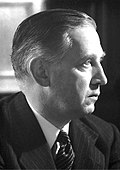 Edward Victor Appleton
Partners
Is this everyone?
Only relatives with a profile here are drawn, so a family can be larger than this. A line here can also be wrong.
Correct this familyAbout this person
Edward Victor Appleton graduated from Cambridge, served as a second lieutenant in the Royal Engineers during the First World War, and returned from the Western Front with a captured German thermionic valve. By 1924 he was Wheatstone Professor at King's College London, unravelling how radio waves were created, propagated, and reflected by the upper atmosphere. He returned to Cambridge in 1936 as Jacksonian Professor and became acting director of the Cavendish Laboratory after Ernest Rutherford died that October. In 1939 he became Secretary of the Department of Scientific and Industrial Research, marshalling Britain's scientific knowledge for the war effort and overseeing radar development - an outgrowth of his ionosphere work. He also ran Tube Alloys, the British nuclear weapons project, until it merged into the Manhattan Project in 1943. The Nobel came in 1947. He spent his final seventeen years as Principal and Vice-Chancellor of the University of Edinburgh, overseeing its growth and the controversial redevelopment of George Square.
In common with Edward
 Charles Thomson Rees WilsonBoth received Gunning Victoria Jubilee Prize
 Charles H. TownesBoth received IEEE Morris N. Liebmann Memorial Award
 Martin RyleBoth received IEEE Morris N. Liebmann Memorial Award
 James DewarBoth received Gunning Victoria Jubilee Prize
 William Thomson, 1st Baron KelvinBoth received Gunning Victoria Jubilee Prize
 Claude ShannonBoth received IEEE Morris N. Liebmann Memorial Award
Fame.am measures public visibility signals. It does not measure human value, talent, morality, or credibility.