Edmund Burke
Anglo-Irish statesman, political theorist and conservative philosopher (1729-1797) · Politicians · Died at 68
Edmund Burke is read about 1,495 times a day, in 82 languages.
A typical day, 30 days to 23 October 2026
The middle day of the days counted, so one week of news cannot move it. The line under it is the last 398 days, one point a day.
Something wrong?An 18th-century Anglo-Irish politician who watched the French Revolution unfold and wrote the text that became conservatism's founding document - arguing that tearing down old institutions destroys more than it saves.
A life in dates
Also in Deutsch
Photos 8
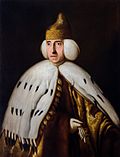
 Sir Joshua Reynolds - Edmund Burke, 1729 - 1797. Statesman, orator and author - PG 2362 - National Galleries of Scotland
 "Crumbs of comfort", or-old-orthodox, restoring consolation to his fallen children. (BM 1851,0901.107)
 "Pity the sorrows of a poor man".Vide, Scene in Bloomsbury Square (BM 1851,0901.780)
 "Pity the sorrows of a poor man".Vide, Scene in Bloomsbury Square (BM 1868,0808.6505)
 (Burke) on the sublime and beautiful by Thomas Cornell
 (Fragment of a strip design.) (BM 1868,0808.5865)
 EdmundBurke1771
 Edmund Burke by James Northcote
In their own words 10
 ,
In the interval between his campaigns Agricola was employed in the great labours of peace.
The writers against religion, whilst they oppose every system, are wisely careful never to set up any of their own.
War," says Machiavel, "ought to be the only study of a prince;" and by a prince he means every sort of state, however constituted.
In their orbit
About this person
Edmund Burke spent nearly three decades as a Whig MP in the House of Commons, from 1766 to 1794, defending causes that didn't always align: he supported the American colonists' right to resist British taxes (though not independence), pushed for Catholic emancipation, and led the impeachment effort against Warren Hastings of the East India Company. In 1790, watching the French Revolution consume the church and ancien régime, he published Reflections on the Revolution in France, asserting that revolution was shredding the fabric of good society and that manners, religious institutions, and inherited structures were essential to moral stability. The book split the Whigs - Burke led the Old Whigs against Charles James Fox's pro-revolution faction - and made him a lodestone for conservatives on both sides of the Atlantic. He died in 1797, but the argument lived: by the 20th century, Burke was credited as the philosophical founder of modern conservatism, his warnings about unchecked change still cited whenever tradition and upheaval collide.



Fame.am measures public visibility signals. It does not measure human value, talent, morality, or credibility.