Diophantus
3rd century Alexandrian Greek mathematician · Egypt · Academics · Lived 200 to 284 · aged 84
Diophantus is read about 223 times a day, in 73 languages.
A typical day, 30 days to 15 October 2026
The middle day of the days counted, so one week of news cannot move it. The line under it is the last 390 days, one point a day.
Something wrong?An Alexandrian mathematician whose margin note became the most famous tease in math history - not his own note, but Fermat's, scribbled in a 1621 edition of his work claiming a proof "too large for this margin." The equations he left behind now anchor entire branches of number theory.
Also in Deutsch
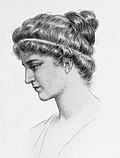
Photos 1

In their own words 1
 ,
If we arrive at an equation containing on each side the same term but with different coefficients, we must take equals from equals until we get one term equal to another term.
About this person
Diophantus of Alexandria flourished around 250 CE and authored the Arithmetica in thirteen books, ten still extant, working through arithmetical problems solved by algebraic equations. Lagrange later called him "the inventor of algebra"; his methods became standard in Neoplatonic schools of late antiquity, then shaped medieval Arabic algebra after a 9th-century translation carried his concepts and procedures east. The 1621 Bachet edition found unexpected immortality when Pierre de Fermat annotated his copy with the Last Theorem in the margin. His legacy now extends beyond that famous marginal drama: Diophantine equations, Diophantine geometry, and Diophantine approximations are subareas of number theory named for him, and problems from the Arithmetica still stir work in abstract algebra.



Fame.am measures public visibility signals. It does not measure human value, talent, morality, or credibility.