Deng Xiaoping
Chinese politician and paramount leader from 1978 to 1989 · China · Politicians · Lived 1904 to 1997 · aged 92
Deng Xiaoping is read about 6,934 times a day, in 109 languages.
A typical day, 30 days to 15 October 2026
The middle day of the days counted, so one week of news cannot move it. The line under it is the last 390 days, one point a day.
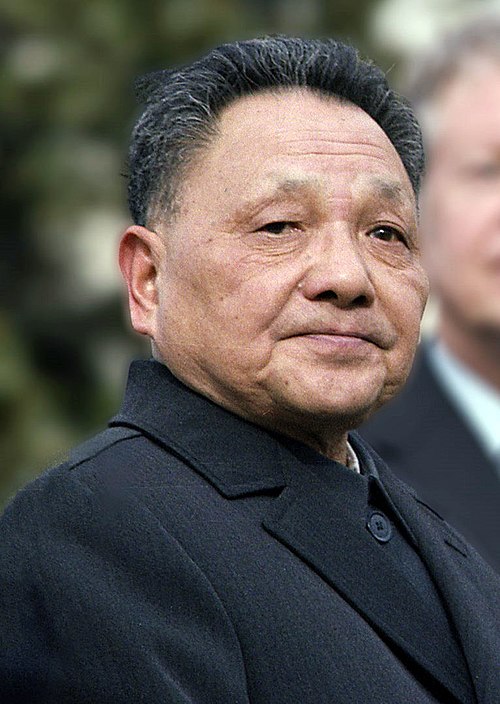
Something wrong?The paramount leader who took a fractured, Maoist China in 1978 and rewired it into a socialist market economy - special zones, foreign capital, constitutional term limits - then crushed the 1989 Tiananmen protests and set the template for the superpower that followed.
A life in dates
Also in Deutsch
Photos 11

 Deng Xiaoping at age 16, studying in France (1921)
 Deng's name is spelled "Teng Hi Hien" on this employment card from the Hutchinson shoe factory in Châlette-sur-Loing, France, where he worked for eight months in 1922, and for another stint in 1923 where he was fired after one month, with the bottom note reading 'refused to work, do not take him back'
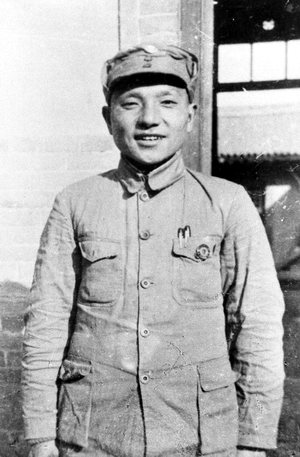 Deng Xiaopingin NRA uniform, 1937
 Deng with Liu Bocheng (right)
 Deng Xiaoping (centre) with U.S. president Gerald Ford (left), 1975
 Deng Xiaoping and Jimmy Carter at the arrival ceremony of Deng's visit to the US (1979)
In their own words 10
 ,
A basic contradiction between socialism and the market economy does not exist.
The key to the four modernizations is the modernization of science and technology.
Marxism has consistently treated science and technology as part of the productive forces.
Awards
Family
Deng XiaopingPartners


Children


Is this everyone?
Only relatives with a profile here are drawn, so a family can be larger than this. A line here can also be wrong.
Correct this familyAbout this person
Born to a landowning family in Sichuan in 1904, Deng Xiaoping absorbed Marxism in France during the 1920s Work-Study Movement, studied in Moscow, and joined the Chinese Communist Party in 1924. He survived the Long March as a Red Army political commissar, helped deliver the 1949 victory, and rose to vice premier and party secretary-general under Mao - until the Cultural Revolution branded him "number two capitalist roader" and sent him to a tractor factory for four years. After Mao died in 1976, Deng outmaneuvered rivals and by 1978 commanded the country. He launched reform and opening up: market incentives, special economic zones, the one-child policy, nine-year compulsory education, the 863 technology program, and the 1982 Constitution with term limits. The deals for Hong Kong and Macau bore his "one country, two systems" formula. Time named him Person of the Year twice. Then in June 1989 he ordered tanks into Tiananmen Square, ending his political liberalization and staining the record that had already made China a rising power.
Politicians from China 6


Fame.am measures public visibility signals. It does not measure human value, talent, morality, or credibility.