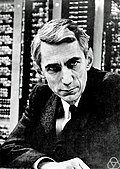
Claude Shannon
American mathematician and information theorist (1916-2001) · United States · Academics · Died at 84
Claude Shannon is read about 2,218 times a day, in 69 languages.
A typical day, 30 days to 20 October 2026
The middle day of the days counted, so one week of news cannot move it. The line under it is the last 395 days, one point a day.
Something wrong?He proved that ones and zeros could think. Shannon's master's thesis - written at 21 - showed how Boolean algebra could build any logical circuit, a blueprint that made every digital device possible.
A life in dates
Also in Deutsch
Photos 8

.jpg?width=1200)


.jpg?width=1200)
.jpg?width=1200)


In their own words 4
 ,
, Omni: Do you find it depressing that chess computers are getting so strong? Shannon: I am not depressed by it. I am rooting for the machines!
My greatest concern was what to call it.
This duality can be pursued further and is related to a duality between past and future and the notions of control and knowledge.
Awards
In their orbit 2
About this person
Shannon dual-degreed in electrical engineering and mathematics at the University of Michigan in 1936, then arrived at MIT for a master's. His 1937 thesis demonstrated that electrical circuits using Boolean algebra could construct any logical relationship - the theory behind all digital computing, called by some the most important master's thesis ever written. He earned his PhD in mathematics in 1940, then spent World War II on cryptanalysis for the U.S., writing foundational work that closed classical cryptography and opened the modern era. In 1948 he published "A Mathematical Theory of Communication", which defined information as a measurable quantity and created the field of information theory - the backbone of the Internet, mobile telephony, compact discs, and more. He formally introduced the term "bit", co-invented pulse-code modulation and the first wearable computer, co-organized the 1956 Dartmouth workshop that founded artificial intelligence as a discipline, and built Theseus, an electrical mouse that learned by trial and error. He taught at MIT from 1956 to 1978 and won the Kyoto Prize in 1985.
In common with Claude
 Leo EsakiBoth received IEEE Morris N. Liebmann Memorial Award
 Charles H. TownesBoth received IEEE Morris N. Liebmann Memorial Award
 Paul BaranBoth received Edwin Howard Armstrong Achievement AwardSheldon RobertsBoth received Noble Prize
 Charles K. KaoBoth received IEEE Morris N. Liebmann Memorial Award
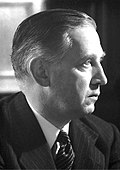 Edward Victor AppletonBoth received IEEE Morris N. Liebmann Memorial Award
Fame.am measures public visibility signals. It does not measure human value, talent, morality, or credibility.