Carl Gustaf Emil Mannerheim
Finnish military leader and statesman (1867-1951) · Finland · Politicians · Died at 83 · also Russia
Carl Gustaf Emil Mannerheim is read about 1,720 times a day, in 78 languages.
A typical day, 30 days to 15 October 2026
The middle day of the days counted, so one week of news cannot move it. The line under it is the last 390 days, one point a day.
Something wrong?He fought for the Russian Empire, then against the Bolsheviks to secure Finland's independence, led the country through two wars with the Soviet Union, and died revered as the greatest Finn of all time - a monarchist who ratified a republic, a general who became president, a man who parceled out survival against...
A life in dates
Also in Deutsch
Photos 12

 The Mannerheim siblings, c. 1880; Gustaf is standing on the right
 Mannerheim (right) with a fellow student, Antanas Ričardas Druvė, in Nicholas Cavalry College, Saint Petersburg, late 1880s.
 After his coronation, Nicholas II of Russia leaves Dormition Cathedral. The Chevalier Guard Lieutenant marching in front to the Tsar's left (to the viewer's right) is Mannerheim.
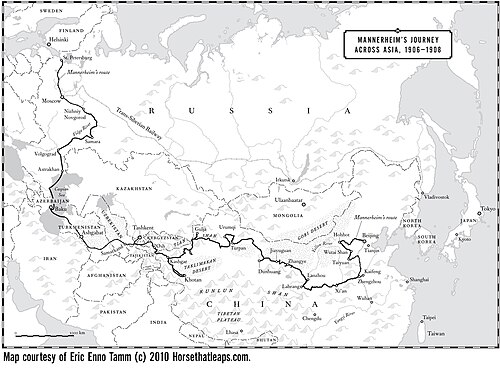 Gustaf Mannerheim's route across Asia from Saint Petersburg to Peking, 1906-1908.[66]
 The expedition of Mannerheim
 Kurmanjan Datka on horseback, photograph taken by Carl Gustaf Emil Mannerheim
 Anastasia Arapova, Mannerheim's wife, in 1896
Awards
Family
Parents


 Carl Gustaf Emil Mannerheim
Partners


Brothers and sisters


Is this everyone?
Only relatives with a profile here are drawn, so a family can be larger than this. A line here can also be wrong.
Correct this familyAbout this person
Born into Swedish-speaking aristocracy in the Grand Duchy of Finland in 1867, Mannerheim rose to lieutenant general in the Imperial Russian Army, serving through the Russo-Japanese War and World War I. After Finland declared independence in December 1917, he commanded the Whites to victory in the 1918 civil war and served as regent, securing international recognition of the new republic despite his own monarchist leanings. He lost the first presidential election in 1919 and withdrew from politics, spending years leading the Red Cross and child welfare work until 1931, when he was appointed to prepare Finland's defenses against the Soviet Union. When the Soviets invaded in November 1939, he took command for what became five years of war - the Winter War, the Continuation War alongside Nazi Germany, and finally the Lapland War after Parliament unanimously made him president in 1944 to negotiate peace. He resigned in 1946, his health broken, and died in a Swiss sanatorium in 1951, leaving behind a country that called him the father of modern Finland.


Fame.am measures public visibility signals. It does not measure human value, talent, morality, or credibility.