C. V. Raman
Indian physicist (1888-1970) · India · Scientists · Died at 82
C. V. Raman is read about 1,177 times a day, in 108 languages.
A typical day, 30 days to 15 October 2026
The middle day of the days counted, so one week of news cannot move it. The line under it is the last 390 days, one point a day.
Something wrong?He proved that light bends its own rules. When C. V. Raman sent light through transparent matter, it came out changed - a different wavelength, a new color - rewriting what physicists thought possible and handing India its first Nobel in the sciences.
A life in dates
Also in Deutsch
Photos 8
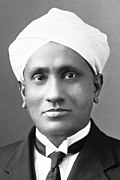
 Sir CV Raman
 1928 Benzene Raman Spectrum
 BA class of 1903, Presidency College, Madras
 C V Raman 1924
 C.v.raman, statue at z.p.h school, madanapalle, chittur district
 CV Raman bust BITM
_(page_372_crop).jpg?width=1200) Mr. C. V. Raman in The Modern Review Vol 15 (January to June 1914) (page 372 crop)
Mr. C. V. Raman in The Modern Review Vol 15 (January to June 1914) (page 372 crop) National science day - physical science for ever
In their own words 10
 ,
, I strongly believe that fundamental science cannot be driven by instructional, industrial and government or military pressures.
If there is a God we must look for him in the Universe. If he is not there, he is not worth looking for. I am being looked upon in various quarters as an atheist, but I am not.
There is no Heaven, no Swarga, no Hell, no rebirth, no reincarnation and no immortality. The only thing that is true is that a man is born, he lives and he dies.
Awards
Family
Parents
C. V. RamanPartners
Children

Brothers and sisters
Is this everyone?
Only relatives with a profile here are drawn, so a family can be larger than this. A line here can also be wrong.
Correct this familyAbout this person
Born in Tamil Nadu in 1888, Raman tore through school, finishing his bachelor's in physics at 16 and publishing on light diffraction while still a graduate student. He joined the Indian Finance Service at 19 as an accountant in Calcutta, but spent his nights at the Indian Association for the Cultivation of Science, running experiments in acoustics and optics on his own time. In 1917 he became the first Palit Professor of Physics at Rajabazar Science College; a sea voyage to Europe convinced him the prevailing explanation for the ocean's blue was wrong. Using a spectrograph he built, he and student K. S. Krishnan discovered in 1928 that light scattering through transparent materials shifts wavelength - the Raman effect. Two years later he took the Nobel Prize in Physics, the first Asian and non-White laureate in the field. He directed the Indian Institute of Science from 1933, founded the Indian Academy of Sciences, and in 1948 opened the Raman Research Institute in Bengaluru, where he worked until his death in 1970.



Fame.am measures public visibility signals. It does not measure human value, talent, morality, or credibility.