B. F. Skinner
American behaviorist (1904-1990) · United States · Academics · Died at 86
B. F. Skinner is read about 1,293 times a day, in 72 languages.
A typical day, 30 days to 15 October 2026
The middle day of the days counted, so one week of news cannot move it. The line under it is the last 390 days, one point a day.
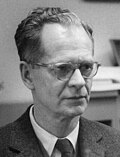
Something wrong?He built a box to prove that free will might be an illusion. B. F. Skinner believed behavior was shaped entirely by consequences - reward and punishment, nothing mystical - and spent decades running experiments that made the idea impossible to ignore.
A life in dates
Also in Deutsch
Photos 8
.jpg?width=1200)


In their own words 10
 ,
, In trying to solve the terrifying problems that face us in the world today, we naturally turn to the things we do best.
We admire people to the extent that we cannot explain what they do, and the word "admire" then means "marvel at.
A person who has been punished is not thereby simply less inclined to behave in a given way; at best, he learns how to avoid punishment.
Awards
Family
B. F. SkinnerPartners
Children

Is this everyone?
Only relatives with a profile here are drawn, so a family can be larger than this. A line here can also be wrong.
Correct this familyAbout this person
Born in 1904, Skinner started as a would-be novelist before pivoting to psychology and landing at Harvard, where he spent most of his career. He invented the operant conditioning chamber and the cumulative recorder to track how rats and pigeons responded to reinforcement, then codified the findings with Charles Ferster in their 1957 book Schedules of Reinforcement. His 1948 novel Walden Two imagined a society engineered on behaviorist principles, and his 1958 work Verbal Behavior extended the framework to language itself. He published 21 books and 180 articles before retiring in 1974. A 2002 survey named him the most influential psychologist of the 20th century - architect of radical behaviorism, which insisted that everything we do is learned, not willed.
In common with B.
 Henry MurrayBoth received Kenneth D. Herman, Ph.D., J.D. Career Contribution Award
 David McClellandBoth received Kenneth D. Herman, Ph.D., J.D. Career Contribution Award
 Carol GilliganBoth received Kenneth D. Herman, Ph.D., J.D. Career Contribution AwardJerome KaganBoth received Kenneth D. Herman, Ph.D., J.D. Career Contribution Award
Academics from the United States 2


Fame.am measures public visibility signals. It does not measure human value, talent, morality, or credibility.