Aryabhata is read about 631 times a day, in 91 languages.
A typical day, 30 days to 21 October 2026
The middle day of the days counted, so one week of news cannot move it. The line under it is the last 396 days, one point a day.
Something wrong?A fifth-century mathematician who calculated pi to four decimal places, explained eclipses without mythology, and described Earth's rotation a thousand years before Copernicus - all while most of the world still thought the planet sat still.
Also in Deutsch
Photos 8


In their own words 6
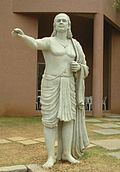 ,
, The globe of the Earth stands supportless in space...
When sixty times sixty years and three quarter yugas (of the current yuga) had elapsed, twenty three years had then passed since my birth.
100 plus 4, multiplied by 8, and added to 62,000: this is the nearly approximate measure of the circumference of a circle whose diameter is 20,000.
About this person
Born in 476 CE, Aryabhata published the Āryabhaṭīya at twenty-three, a text that would anchor Indian astronomy for centuries. In it he laid out the place-value system, solved quadratic equations, and computed sine tables with startling precision. He also wrote the Arya-siddhanta, now lost. His assertion that Earth rotates on its axis - and that celestial motion is relative to the observer - marked him as an early physicist, not just a stargazer with an abacus. He died in 550, leaving a body of work that traveled as far as the Islamic world and beyond.





Fame.am measures public visibility signals. It does not measure human value, talent, morality, or credibility.