Arnold Schoenberg is read about 1,106 times a day, in 73 languages.
A typical day, 30 days to 15 October 2026
The middle day of the days counted, so one week of news cannot move it. The line under it is the last 390 days, one point a day.
Something wrong?He shattered the gravitational pull of tonality and invented a system where all twelve notes stood equal - no home key, no resolution, just rigorous pattern. Schoenberg's twelve-tone technique divided the music world into disciples and enemies, but it reset the terms of what composition could mean in the 20th century.
A life in dates
Also in Deutsch
Photos 8
 Arnold schönberg man ray
 Ariane Matiakh
%2C_compositeur_autrichien_(CN)_-_btv1b53141950j.jpg?width=1200) Arnold Schonberg (i.e. Schoenberg), compositeur autrichien (CN) - btv1b53141950j
Arnold Schonberg (i.e. Schoenberg), compositeur autrichien (CN) - btv1b53141950j Arnold Schönberg Herzgewächse Der blaue Reiter 1912 221
 Casa d'Arnold Schönberg a Barcelona
 Concerto for Violin op. 36. Row structure
 Das Sakko Arnold Schönbergs. Prager Tagblatt, Mai 1924
 Koalitionsschach
In their own words 10
 ,
, My work should be judged as it enters the ears and heads of listeners, not as it is described to the eyes of readers.
If music is frozen architecture, then the potpourri is frozen coffee-table gossip... Potpourri is the art of adding apples to pears…
There are no more geniuses, only critics.
Listen
SpotifyAlbums 24
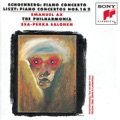 SNSchoenberg: Piano Concerto / Liszt: Piano Concertos Nos. 1 & 2
 SFSchoenberg: Gurrelieder / Scriabin: Poem of Ecstasy / Poem of Fire
Awards
Family
Arnold SchoenbergPartners
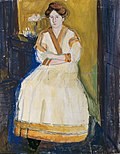
Children

Is this everyone?
Only relatives with a profile here are drawn, so a family can be larger than this. A line here can also be wrong.
Correct this familyAbout this person
Schoenberg began in late-Romantic Vienna, blending Brahms and Wagner in early works like Verklärte Nacht (1899) and Gurre-Lieder (1900-1903). He mentored Webern and Berg as part of the Second Viennese School and pushed into atonal expressionism with pieces like Erwartung (1909) and Pierrot lunaire (1912). Growing antisemitism and a spiritual turn - partly inspired by Mahler - drove him toward a governing principle to replace tonality, and by 1923 he'd codified twelve-tone technique, structuring works like Moses und Aron and the Variations for Orchestra through intervallic cells and combinatorial rows. He fled Nazi Europe, reaffirmed his Judaism, and taught at UCLA from 1936. After the war he memorialized Holocaust victims in A Survivor from Warsaw (1947), wrote his String Trio while ill, and accepted honorary presidency of Israel's conservatory months before his death in 1951.


Fame.am measures public visibility signals. It does not measure human value, talent, morality, or credibility.