Antoine Lavoisier
French nobleman and chemist (1743-1794) · France · Scientists · Died at 50
Antoine Lavoisier is read about 2,397 times a day, in 111 languages.
A typical day, 30 days to 22 October 2026
The middle day of the days counted, so one week of news cannot move it. The line under it is the last 397 days, one point a day.
Something wrong?He turned chemistry from guesswork into measurement, named oxygen, buried phlogiston, and built the metric system - then lost his head to the guillotine for the crime of collecting taxes under the old regime.
A life in dates
Also in Deutsch
Photos 8
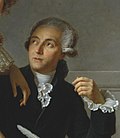
 David - Portrait of Monsieur Lavoisier (cropped)
 A. L. Lavoisier, S. Th. v. Soemmering- Farl von Linné, sir H. Davy CIPB0950
 Annales de Chimie Titlepage Volume 1
 Antoine Laurent de Lavoisier (1743-1794), chimiste, 1802, ND681(2)
 Antoine Laurent de Lavoisier (1743-1794), chimiste, 1802, ND681(3)
 Antoine Laurent de Lavoisier (1743-1794), chimiste, 1802, ND681(4)
 Antoine Laurent de Lavoisier (1743-1794), chimiste, 1802, ND681
 Antoine Laurent de Lavoisier (1743-1794), chimiste, ND340(2)
In their own words 3
 ,
Here, then: a revolution [in science and chemistry] has taken place in an important part of human knowledge since your departure from Europe...
We must trust to nothing but facts: These are presented to us by Nature, and cannot deceive.
The art of concluding from experience and observation consists in evaluating probabilities, in estimating if they are high or numerous enough to constitute proof.
Awards
Family
Parents
Antoine LavoisierPartners

Is this everyone?
Only relatives with a profile here are drawn, so a family can be larger than this. A line here can also be wrong.
Correct this familyAbout this person
Lavoisier came from French nobility and used his position on aristocratic councils and as an administrator of the Ferme générale - the ancien régime's most hated tax apparatus - to bankroll his laboratory work. Through more precise measurement than his predecessors, he confirmed that mass stays constant in closed systems even as matter changes form, laying the ground for balanced equations. He discovered oxygen's role in combustion in the 1770s, named it in 1778, recognized hydrogen as an element in 1783, helped construct the metric system, and wrote the first extensive list of elements in 1787, predicting silicon's existence. His wife and laboratory assistant, Marie-Anne Paulze Lavoisier, became a renowned chemist and worked beside him on the metric reforms. When the Revolution came, his aristocratic ties and role in tax collection caught up with him: charged with fraud and selling adulterated tobacco, he was guillotined on 8 May 1794 despite appeals to spare him for his scientific contributions. Eighteen months later, the government exonerated him.
In common with Antoine

Scientists from France 5


Fame.am measures public visibility signals. It does not measure human value, talent, morality, or credibility.