Aleksandr Vasilevsky
Marshal of the Soviet Union (1895-1977) · Russia · Politicians · Died at 82
Aleksandr Vasilevsky is read about 856 times a day, in 51 languages.
Counted to 16 September 2026, not since.
The middle day of the days counted, so one week of news cannot move it. The line under it is the last 60 days, one point a day.
Something wrong?The Soviet general who climbed from Imperial Army captain to Marshal, survived Stalin's purges, and spent World War II coordinating entire fronts from the General Staff - then led the lightning invasion of Manchuria that ended the Pacific war.
A life in dates
Also in Deutsch
Photos 8


In their own words 3
 ,
I did not decide to become an officer to start a military career. I still wanted to be an agronomist and work in some remote corner of Russia after the war.
Why I should be in Romania in the name of unknown to me goal. There was a time when I led soldiers to battle, thinking I was doing my duty as a Russian patriot.
By seizing the formerly little-known Height 102.0 - the Mamayev Hill - the Red Army fought its way to the fascists' den - Berlin.
Awards
Family
Aleksandr VasilevskyChildren
Is this everyone?
Only relatives with a profile here are drawn, so a family can be larger than this. A line here can also be wrong.
Correct this familyAbout this person
Aleksandr Vasilevsky began as an officer in the Imperial Russian Army during World War I, reaching captain by 1917 before the revolution pulled him into the Red Army and the Polish-Soviet War. He rose fast through the interwar ranks, appointed to the Directorate of Military Training in 1931 and then deputy chief of operations in 1939 after Stalin's purges had thinned the officer corps. When Germany invaded in June 1941, his mentor Boris Shaposhnikov recommended him for promotion; by June 1942 Vasilevsky had succeeded Shaposhnikov as chief of the General Staff and became deputy defense minister that October. In that role he coordinated fronts and planned offensives with Georgy Zhukov - Kursk in 1943, Operation Bagration in 1944 - and earned his marshal's star in February 1943 after Stalingrad. He took field command of the 3rd Belorussian Front in February 1945, then pivoted east: appointed commander-in-chief of Soviet forces in the Far East in July, he executed the invasion of Manchuria in August 1945. After the war he held the General Staff again from 1946 to 1948 and served as Defense Minister from 1949 until after Stalin's death, finally removed in 1957 under
In common with Aleksandr
 Ivan BagramyanBoth received Honorary weapon with a golden image of the State Emblem of the USSR
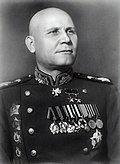 Ivan KonevBoth received Honorary weapon with a golden image of the State Emblem of the USSR
 Konstantin RokossovskyBoth received Honorary weapon with a golden image of the State Emblem of the USSR
 Semyon TimoshenkoBoth received Honorary weapon with a golden image of the State Emblem of the USSR
 Semyon BudyonnyBoth received Honorary weapon with a golden image of the State Emblem of the USSR
 Vasily ChuikovBoth received Honorary weapon with a golden image of the State Emblem of the USSR
Fame.am measures public visibility signals. It does not measure human value, talent, morality, or credibility.