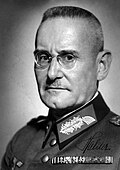
Albert Kesselring
German Luftwaffe Generalfeldmarschall during World War II (1885-1960) · Germany · Writers · Died at 74
Albert Kesselring is read about 1,387 times a day, in 49 languages.
A typical day, 30 days to 12 October 2026
The middle day of the days counted, so one week of news cannot move it. The line under it is the last 387 days, one point a day.
Something wrong?A Luftwaffe field marshal who commanded German forces across three theatres in World War II, then stood trial for ordering the execution of 335 Italian civilians in the Ardeatine massacre and reprisals against resistance fighters.
A life in dates
Also in Deutsch
Photos 12

 Kesselring at the controls of a Siebel Fh 104 aircraft
 Kesselring (left), with his chief of staff, Wilhelm Speidel (centre), and Hermann Göring (right) - 1940
 Kesselring in 1940
 North Africa, February 1942. Kesselring (right) meets with Erwin Rommel (left) and Fritz Bayerlein of the Afrika Korps.
 Battle of Gazala
 The Liberty ship SS Robert Rowan explodes spectacularly - but without loss of life - after being hit by a German bomber off Gela, Sicily, on 11 July 1943
 A German anti-tank gun near Salerno
In their own words 7
 ,
, A soldier's first duty is to obey, otherwise you might as well do away with soldiering.
War is possible only if you have a lot of enemies. If all the enemies get together and form one front - if you cut down the number of enemies - there would be no war.
I have always had plenty of friends, and now at age sixty, I face four walls as a common prisoner.
Awards
About this person
Kesselring joined the Bavarian Army as an artillery officer in 1904 and served through World War I on both fronts, reaching the Army Staff without attending the War Academy. Discharged from the Reichswehr in 1933, he moved to the Ministry of Aviation and helped rebuild German air power, serving as Luftwaffe chief of staff from 1936 to 1938. During World War II he commanded air operations in Poland, France, Britain, and the Soviet Union before becoming Wehrmacht Commander-in-Chief South, overseeing the Mediterranean theatre and leading a defensive campaign in Italy until injured in October 1944. Convicted after the war of war crimes for ordering the murder of 335 Italian civilians in the Ardeatine massacre and inciting troops to kill civilians in reprisals against the Italian resistance, he was sentenced to death, later commuted to life imprisonment. Released in 1952 after a political campaign citing health grounds, he published his memoirs in 1953 and accepted honorary presidencies of three veterans' organisations before his death in 1960.




Fame.am measures public visibility signals. It does not measure human value, talent, morality, or credibility.