Alban Berg is read about 366 times a day, in 56 languages.
Counted to 15 September 2026, not since.
The middle day of the days counted, so one week of news cannot move it. The line under it is the last 60 days, one point a day.
Something wrong?Berg made modernism feel. He took Schoenberg's twelve-tone system - the grid that could sound like math - and ran it through the Romantic wringer, writing operas and chamber works that didn't abandon emotion for structure but somehow held both at once.
Also in Deutsch
Photos 7
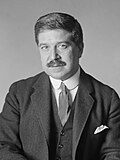
_~1930_%C2%A9_Max_Fenichel_(1885%E2%80%931942).jpg?width=1200) Alban Berg (1885-1935) ~1930 © Max Fenichel (1885-1942)
Alban Berg (1885-1935) ~1930 © Max Fenichel (1885-1942) 2017-08-147 197 Friedhof Hietzing - Alban Berg
 Alban Berg Musikschule 01, Schiefling am Wörthersee, Kärnten
 Grave of Alban Berg, Hietzinger Friedhof
 Infotafel Alban-Berg-Büste vor dem Gemeindeamt Schiefling am Wörthersee, Kärnten
 Mosco Carner Alban Berg 1975 title
 Musical notes in Vienna, Austria
In their own words 1
 ,
, The best music always results from ecstasies of logic.
Listen
SpotifyAlbums 24
 WBWebern / Schoenberg / Berg
 BDBerg: Violin Concerto, 'To the Memory of an Angel' / Hindemith: Violin Concerto / Stravinsky: Violin Concerto in D
In their orbit 2
About this person
Born in Vienna in 1885, Berg started composing at fifteen and studied with Arnold Schoenberg from 1904 to 1911, absorbing the twelve-tone technique and principles of developing variation. Between 1914 and 1922 he completed Wozzeck, an opera that married the new system to Romantic lyricism; he followed with the Lyric Suite, Chamber Concerto, and began Lulu in 1928, left unfinished at his death. Where Schoenberg's modernism could seem austere, Berg's had what one observer called "surface glamour" - a way of folding entire worlds of emotion into the grid, winning admirers when his teacher had few. He died of sepsis in Vienna in December 1935, forty years into a life that left a small catalogue and an outsize mark.



Fame.am measures public visibility signals. It does not measure human value, talent, morality, or credibility.