Alan Turing
English computer scientist (1912-1954) · United Kingdom · Academics · Died at 41
Alan Turing is read about 11,938 times a day, in 164 languages.
A typical day, 30 days to 18 October 2026
The middle day of the days counted, so one week of news cannot move it. The line under it is the last 393 days, one point a day.
Something wrong?He gave the world a working definition of what a computer could be before computers existed, then helped break the ciphers that turned the Battle of the Atlantic - and was prosecuted for being gay two years before cyanide killed him at 41.
A life in dates
Also in Deutsch
Photos 12

 English Heritage blue plaque in Maida Vale, London marking Turing's birthplace in 1912
 Turing at age 16, c. 1928 - c. 1929
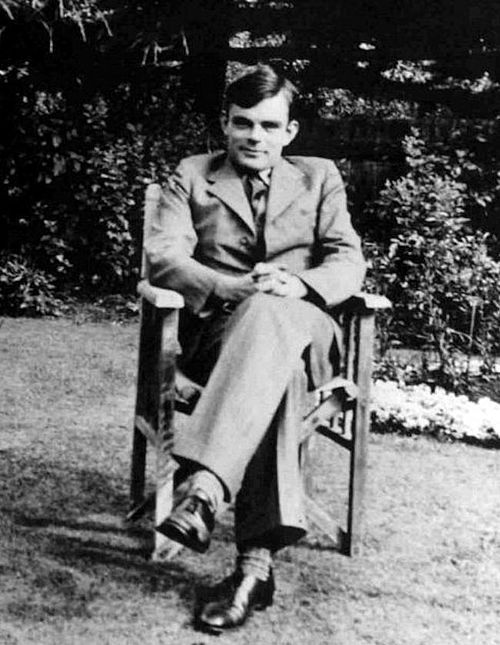 Turing in the 1930s
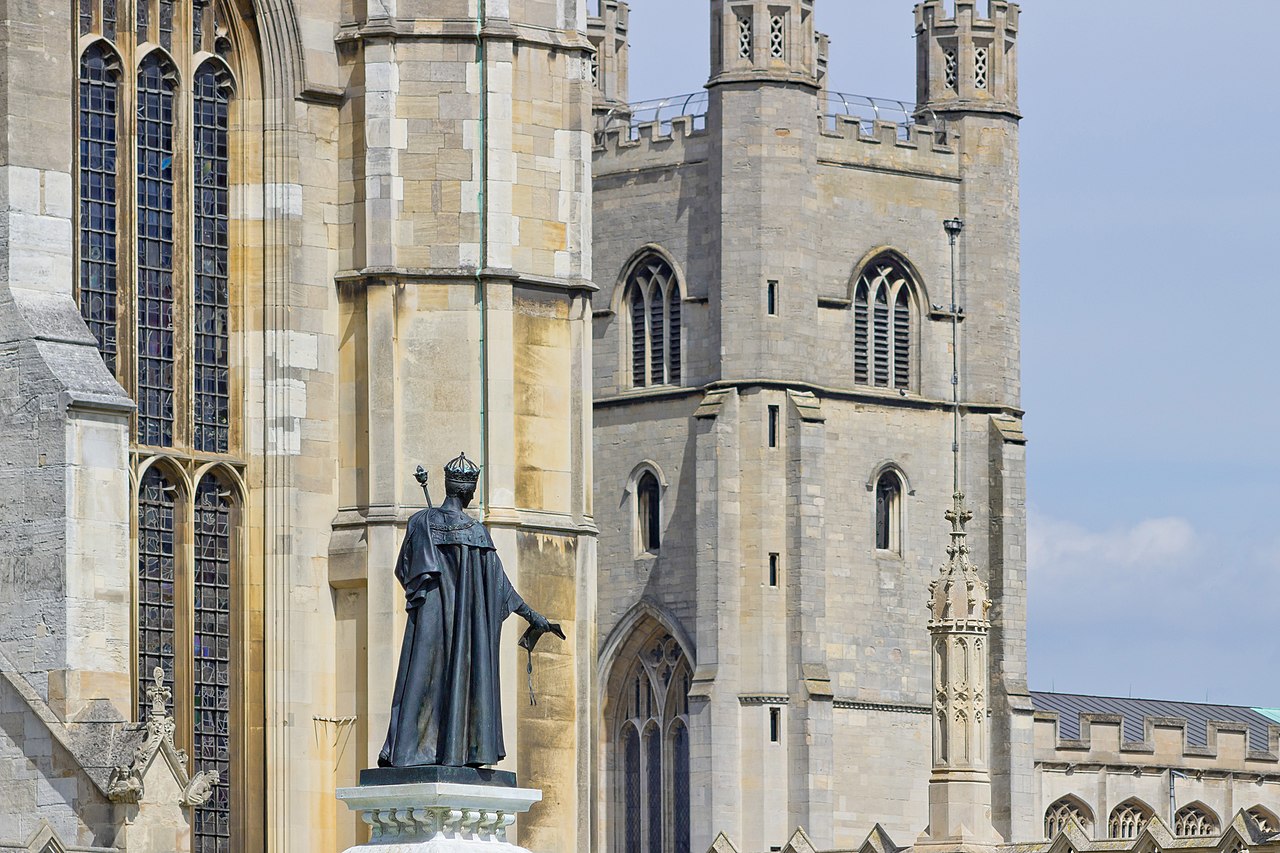 King's College, Cambridge, where Turing was an undergraduate in 1931 and became a Fellow in 1935. The computer room is named after him.
 Two cottages in the stable yard at Bletchley Park. Turing worked here in 1939 and 1940, before moving to Hut 8.
 A working replica of a bombe now at The National Museum of Computing on Bletchley Park
![Statue of Turing holding an Enigma machine by Stephen Kettle at Bletchley Park, commissioned by Sidney Frank, built from half a million pieces of Welsh slate[110]](https://upload.wikimedia.org/wikipedia/commons/thumb/f/f5/Turing-statue-Bletchley_14.jpg/1280px-Turing-statue-Bletchley_14.jpg) Statue of Turing holding an Enigma machine by Stephen Kettle at Bletchley Park, commissioned by Sidney Frank, built from half a million pieces of Welsh slate[110]
Statue of Turing holding an Enigma machine by Stephen Kettle at Bletchley Park, commissioned by Sidney Frank, built from half a million pieces of Welsh slate[110]In their own words 10
 ,
, Science is a differential equation. Religion is a boundary condition.
The Exclusion Principle is laid down purely for the benefit of the electrons themselves, who might be corrupted (and become dragons or demons) if allowed to associate too freely.
Let us now assume, for the sake of argument, that these machines are a genuine possibility, and look at the consequences of constructing them.
Awards
Family
Parents
Alan TuringIs this everyone?
Only relatives with a profile here are drawn, so a family can be larger than this. A line here can also be wrong.
Correct this familyAbout this person
Born in London in 1912, Turing graduated from King's College, Cambridge, and earned his doctorate from Princeton in 1938. During World War II he led Hut 8 at Bletchley Park, devising techniques that cracked the Enigma machine and enabled the Allies to defeat the Axis powers in the Atlantic. After the war he designed the Automatic Computing Engine at the National Physical Laboratory, then joined the University of Manchester in 1948, where he worked on early computers and turned to mathematical biology - writing on morphogenesis and predicting oscillating chemical reactions later observed in the 1960s. In 1952 he was prosecuted for homosexual acts and accepted hormone treatment as an alternative to prison. He died from cyanide poisoning on 7 June 1954, aged 41; an inquest ruled suicide, though accidental poisoning remains consistent with the evidence. Gordon Brown apologized in 2009, the Queen pardoned him in 2013, and his face now appears on the £50 note.
Academics from the United Kingdom 6




Fame.am measures public visibility signals. It does not measure human value, talent, morality, or credibility.