Al-Kindi
Muslim Arab philosopher, mathematician and physician (c.801-873) · Academics · Lived 801 to 870 · aged 69
Al-Kindi is read about 430 times a day, in 73 languages.
A typical day, 30 days to 27 October 2026
The middle day of the days counted, so one week of news cannot move it. The line under it is the last 400 days, one point a day.
Something wrong?The ninth-century Baghdad scholar who brought Greek philosophy into Arabic, broke ciphers with statistical analysis before anyone had a name for statistics, and wrote hundreds of treatises spanning everything from the nature of God to the proper mixing of perfumes.
Also in Deutsch
Photos 8
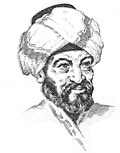
 Al-Kindi Portrait
 Al-Kindi - Cambridge, Trinity College Library, Medieval manuscripts, MS R.15.17 (937), secolo XVII - BEIC 11521297
 Al-Kindi, Abu Yusuf Ya Qub ibn Ishaq - Liber novem iudicum in iudiciis astrorum, 1509 - BEIC 1289632
 Al-kindi-cryptanalysis
 Al-kindi
 Al-Kindī, Sayr mulhimah min al-Sharq wa-al-Gharb
 Stamp IQ 1962 6f (cropped)
 Stamp IQ 1962 6f
In their own words 2
 ,
We should not be ashamed to acknowledge truth from whatever source it comes to us, even if it is brought to us by former generations and foreign peoples.
We ought not to be ashamed of appreciating the truth and of acquiring it wherever it comes from, even if it comes from races distant and nations different from us.
About this person
Born in Kufa around 801, Yaʻqūb ibn ʼIsḥāq al-Kindī was educated in Baghdad and rose to prominence in the House of Wisdom, where Abbasid caliphs appointed him to oversee the translation of Greek scientific and philosophical texts into Arabic. That contact with Hellenistic thought reshaped him: he became the first of the Islamic peripatetic philosophers, synthesizing ancient Greek ideas for a Muslim audience while writing hundreds of original works on metaphysics, medicine, optics, astronomy, and subjects as practical as swords and tides. In mathematics he helped introduce Hindu-Arabic numerals to the Islamic world alongside al-Khwarizmi; in cryptography he pioneered frequency analysis in his Manuscript on Deciphering Cryptographic Messages, giving birth to cryptanalysis and the earliest known use of statistical inference. He spent his career arguing that philosophy and Islamic theology were compatible, writing on God, the soul, and prophetic knowledge for an audience of scholars and theologians. He died around 873, having earned the title "father of Arab philosophy" by making Greek wisdom speak Arabic.


Fame.am measures public visibility signals. It does not measure human value, talent, morality, or credibility.