Abdullah of Saudi Arabia
King of Saudi Arabia from 2005 to 2015 (1924-2015) · Saudi Arabia · Politicians · Died at 90
Abdullah of Saudi Arabia is read about 3,333 times a day, in 98 languages.
A typical day, 30 days to 15 October 2026
The middle day of the days counted, so one week of news cannot move it. The line under it is the last 390 days, one point a day.
Something wrong?King of Saudi Arabia for a decade, he had already been running the country for ten years before that - taking the reins after his half-brother's stroke in 1995 and holding them until his own death in 2015.
A life in dates
Also in Deutsch
Photos 11

 Abdullah as commander of Saudi National Guard
 Abdullah's two predecessors on the throne, King Khalid (left) and King Fahd
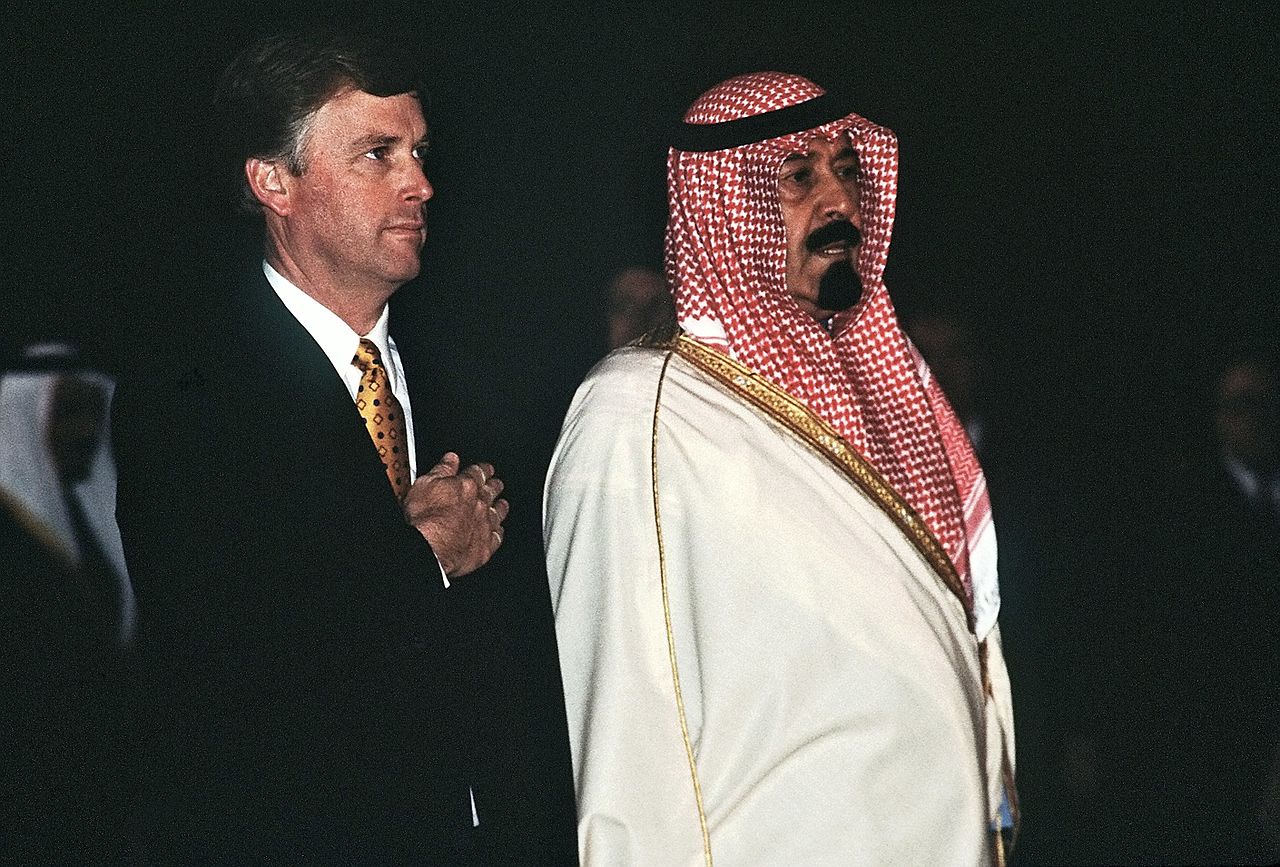 Abdullah with Dan Quayle, 1990
 Royal Standard of the King
 King Abdullah with Vladimir Putin on 11 February 2007
 Abdullah in a meeting with US secretary of state John Kerry, 5 January 2014
 Abdullah visits the United States in April 2005.
In their own words 9
 ,
Cut off the head of the snake
When the Head is Rotten, It Affects the Whole Body
We state with a unified voice that religions through which Almighty God sought to bring happiness to mankind should not be turned into instruments to cause misery
Awards
Family
Parents
 Abdullah of Saudi Arabia
Partners
Children


Brothers and sisters


Is this everyone?
Only relatives with a profile here are drawn, so a family can be larger than this. A line here can also be wrong.
Correct this familyAbout this person
Born in 1924, the tenth son of the kingdom's founder, Abdullah bin Abdulaziz came from a mother whose family had once been the Al Saud's fiercest rivals. He rose through posts that mattered: mayor of Mecca in 1961, commander of the National Guard the next year, a position he never relinquished. Named crown prince in 1982 when his half-brother Fahd became king, Abdullah waited thirteen years before Fahd's stroke made him de facto ruler in 1995. He formally took the throne in 2005 and steered Saudi Arabia through the Arab Spring without yielding ground, kept close ties with Washington and London, and spent billions on arms. He held four of his daughters captive. He married as many as thirty women, fathered more than thirty-five children, and left behind one of the world's great fortunes when he died in January 2015 at ninety, succeeded by yet another half-brother.




Fame.am measures public visibility signals. It does not measure human value, talent, morality, or credibility.