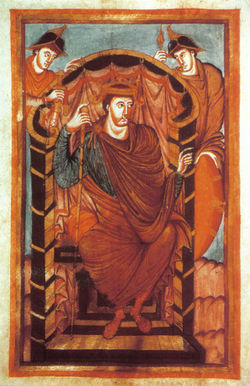
What kind of moment: History, Treaty signing
Treaty of Verdun
- When
- 10 August 843
- Where
- Verdun, Francia
On August 10, 843, three grandsons of Charlemagne signed the Treaty of Verdun to end a brutal civil war over the Carolingian Empire. The agreement carved up the realm into three kingdoms - essentially drawing the map of medieval Europe. It mattered because it established a pattern: empires fracture, kingdoms multiply, and borders shift.
The Treaty of Verdun split Charlemagne's empire into three kingdoms, creating the territorial skeleton of medieval Europe. What emerged from this August 843 partition - West Francia, East Francia, and the Middle Kingdom - would eventually become France, Germany, and a disputed zone that generations would fight over.
In numbers
- Number of surviving sons receiving territory
- 3
- Duration of preceding civil war
- Approximately 3 years (840-843)
How it unfolded
Death of Charlemagne
Charlemagne dies, leaving his empire to his surviving son Louis I.
Death of Louis I
Louis the Pious dies, triggering disputes among his three surviving sons over territorial division.
Lothair I claims the imperial title
Lothair I immediately asserts claims to the entire empire and the imperial crown following his father's death.
Battle of Fontenoy
Charles II and Louis II defeat Lothair I in a decisive battle, forcing negotiations to commence.
Treaty of Verdun signed
The three brothers formally agree to partition the Carolingian Empire into three distinct kingdoms.
Treaty of Meerssen
Charles II and Louis II partition Lothair I's former Middle Kingdom, further fragmenting the empire.
- What followed
962: Emergence of the Holy Roman Empire
- What followed
900: Linguistic divergence
- What followed
1000: Border conflicts over Lothringia