
What kind of moment: History, Riot
Peasants' Revolt
English serfs challenged feudal hierarchy through coordinated uprising, foreshadowing challenges to medieval social order.
- When
- 30 May to November 1381
- Where
- England
- Outcome
- Sacking of Tower of London and mass execution of royal officials; Charters granted to rebel towns; Eventual suppression of revolt and execution of rebel leaders
The Peasants' Revolt didn't topple the monarchy, but it cracked the feudal order. Richard II's willingness to negotiate - however briefly - signaled that peasant grievances couldn't simply be ignored, and the sheer organizational scale of the uprising haunted the English ruling class for generations. Within a decade, most of the rebels' concrete gains had been reversed, but the precedent of mass mobilization stuck.
In numbers
- Trigger
- Poll tax of 1380, levying 3 shillings per head on every person over 15
Where it sits in their lives
 Simon Sudbury1317 to 138164
 Henry le Despenser1341 to 140640
 William Walworth1322 to 138559
- Their age at this moment
How it unfolded
Kent rebels march toward London
Wat Tyler emerges as leader of the Kentish contingent. Thousands of rebels march on London with demands to abolish serfdom and reduce taxes.
Rebels enter London
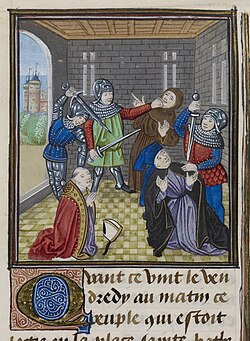
The rebel army breaches London's gates. They burn the Savoy Palace (residence of John of Gaunt) and storm the Tower of London, executing Archbishop Sudbury and Treasurer Robert Hales.
Smithfield meeting with the King
King Richard II, aged 14, meets Wat Tyler at Smithfield. Tyler is struck down during negotiations; accounts differ on whether the blow was fatal or followed by execution. The rebel army begins to disperse.
Royal army disperses remaining rebels
Richard II's forces pursue and scatter the remaining rebel contingents. Summary executions begin; hundreds of participants are arrested.
Executions accelerate across the realm
Justices travel the country executing captured rebels. Chief among them is William Walworth, Lord Mayor of London, who personally executed Wat Tyler.
King rescinds concessions
Richard II formally revokes all charters and promises made to the rebels, declaring them null and void. The poll tax remains repealed, but serfdom continues.
- What followed
1381: Immediate repression and executions
- What followed
1382: Revocation of royal concessions
- What followed
1400: Accelerated decline of serfdom
More about this riot
Leaders
Wat Tyler (Rebels), Jack Straw, Thomas Baker, John Wrawe, John Ball, William Grindecobbe
Richard II of England (Kingdom of England), William Walworth, Simon Sudbury, Henry Despenser, Robert Hales, Richard Lyons