
What kind of moment: History, Battle
Battle of Marathon
- When
- about 490 BC
In about 490 BC, roughly 10,000 Athenian and Plataean hoplites defeated a much larger Persian invasion force on the plain of Marathon, northeast of Athens. The victory halted Darius I's attempt to conquer Greece and became a defining moment in Western history - proving that a disciplined citizen army could overcome an empire's professional soldiers.
Marathon demonstrated that organized Greek city-states could stand against the Persian Empire's military might. The psychological and strategic victory bought Athens time to prepare for future invasions and helped establish the polis system as a viable alternative to autocratic rule across the Mediterranean.
How it unfolded
- about 490 BC
Persian fleet departs Asia Minor
Datis and Artaphernes lead the Persian expeditionary force across the Aegean toward Greece, beginning Darius I's first invasion attempt.
- about 490 BC
Greek forces mobilize
Athens and Plataea assemble their hoplite armies at Marathon. Miltiades persuades the Athenian generals to engage the larger Persian force rather than wait for siege.
- about 490 BC
The Battle of Marathon
Greek hoplites, arranged in a phalanx formation, charge the Persian line. The Greek center feigns retreat while stronger flanks encircle the Persian force, breaking their formations and routing the army back to their ships.
- about 490 BC
Persians withdraw to Asia
Unable to maintain the invasion without reinforcements and facing a recharged Athenian force, the Persian fleet sails for home. Darius I suspends further Greek conquest attempts for a decade.
- What followed
490 BC: Greek coalition strengthened
- What followed
1850: Western civilization narrative established
Who took part


More about this battle
Before and after, with the same people
- Persian Wars begin at Marathon
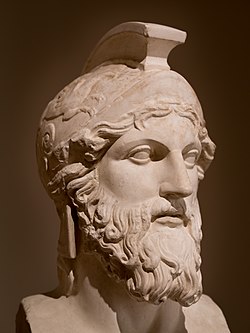
 MiltiadesSee the moment ›
- Battle of Marathon
 Miltiades, Aristides, DatisThis moment