Yukio Mishima is read about 6,607 times a day, in 98 languages.
A typical day, 30 days to 15 October 2026
The middle day of the days counted, so one week of news cannot move it. The line under it is the last 390 days, one point a day.
Something wrong?A novelist nominated five times for the Nobel Prize, then the leader of a failed coup. On 25 November 1970, Mishima walked into a Tokyo military base with four followers, took a hostage, demanded the army restore the emperor's divinity - and when no one rose, performed seppuku as planned.
A life in dates
Also in Deutsch
Photos 12


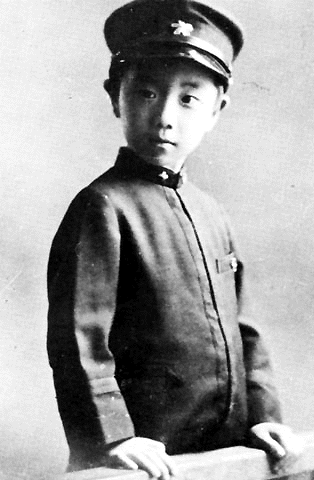 Mishima in his childhood (April 1931, at the age of 6)
 Mishima's self-portrait drawn in junior high school
 Mishima at age 19, with his sister at age 16 (on 9 September 1944)
![Mishima with his cat (Asahigraph, 12 May 1948 issue). He was known as a cat-lover.[100][101] Yōko (his wife) was jealous of his pet cat, and disliked him petting it.[100][101]](https://upload.wikimedia.org/wikipedia/commons/thumb/8/8f/Mishima_Yukio_1948.JPG/500px-Mishima_Yukio_1948.JPG) Mishima with his cat (Asahigraph, 12 May 1948 issue). He was known as a cat-lover.[100][101] Yōko (his wife) was jealous of his pet cat, and disliked him petting it.[100][101]
Mishima with his cat (Asahigraph, 12 May 1948 issue). He was known as a cat-lover.[100][101] Yōko (his wife) was jealous of his pet cat, and disliked him petting it.[100][101] Mishima aged 28(in January 1953)
 Yukio Mishima (lower) with Shintaro Ishihara in 1956 (on the roof of the Bungeishunjū Building in Ginza 6-chome)
In their own words 10
 ,
, Just let matters slide. How much better to accept each sweet drop of the honey that was Time, than to stoop to the vulgarity latent in every decision.
According to Eshin's "Essentials of Salvation," the Ten Pleasures are but a drop in the ocean when compared to the joys of the Pure Land.
I've never done much, but I've lived my whole life thinking of myself as the only real man.
Awards
Family
Parents
Yukio MishimaPartners
Children
Brothers and sisters

Is this everyone?
Only relatives with a profile here are drawn, so a family can be larger than this. A line here can also be wrong.
Correct this familyAbout this person
Born Kimitake Hiraoka on 14 January 1925, he wrote under the pen name Yukio Mishima and became one of postwar Japan's most important stylists - luxurious vocabulary, decadent metaphors, a fusion of traditional Japanese and modern Western forms. Novels like Confessions of a Mask and The Temple of the Golden Pavilion brought him international attention; by the 1960s he was nominated for the Nobel five times, including in 1968 when it went to his countryman Yasunari Kawabata. But from his mid-30s his far-right ideology sharpened: he opposed Western materialism, postwar democracy, and what he saw as Japan's loss of national essence. In 1968 he formed the Tatenokai, a private militia meant to protect the emperor's symbolic dignity and reclaim prewar values of loyalty. On 25 November 1970, Mishima and four members entered a military base in central Tokyo, took the commandant hostage, and tried to inspire the Self-Defense Forces to overthrow Article 9 and restore autonomous defense. No one followed. He committed seppuku that day, as he had planned.



Fame.am measures public visibility signals. It does not measure human value, talent, morality, or credibility.