Wernher von Braun
German and later American aerospace engineer and space architect (1912-1977) · United States · Scientists · Died at 65 · also Germany
Wernher von Braun is read about 4,207 times a day, in 86 languages.
A typical day, 30 days to 22 October 2026
The middle day of the days counted, so one week of news cannot move it. The line under it is the last 397 days, one point a day.
Something wrong?The engineer who put Americans on the Moon built his reputation on Nazi rockets that killed thousands. His trajectory from V-2 architect to NASA director is a Cold War calculus: how much past do you trade for a future in space?
A life in dates
Also in Deutsch
Photos 12

 Von Braun with Fritz Todt, who utilized forced labor for major works across occupied Europe. Von Braun is wearing the Nazi party badge on his suit lapel.
 First rank, from left to right, General Walter Dornberger (partially hidden), General Friedrich Olbricht (with Knight's Cross), Major Heinz Brandt, and Wernher von Braun (in civilian dress) at Peenemünde, Province of Pomerania, in March 1941
 Schematic of the A4/V2
 A regular He 112
 Von Braun, with his arm in a cast, Walter Dornberger (on the left) and Bernhard Tessmann (on the right) surrendered to the Americans just before this 3 May 1945 photo.
 Wernher von Braun at a meeting of NACA's Special Committee on Space Technology, 1958
 Von Braun's badge at ABMA (1957)
In their own words 10
 ,
For me, the idea of a creation is not conceivable without invoking the necessity of design.
My experiences with science led me to God. They challenge science to prove the existence of God. But must we really light a candle to see the sun?
It is in scientific honesty that I endorse the presentation of alternative theories for the origin of the universe, life and man in the science classroom.
Awards
Family
Wernher von BraunPartners


Brothers and sisters


Is this everyone?
Only relatives with a profile here are drawn, so a family can be larger than this. A line here can also be wrong.
Correct this familyAbout this person
Wernher von Braun joined the Nazi Party and SS to advance his rocket work, and at Peenemünde during World War II he helped design the V-2, which became the first object to cross into space on 20 June 1944. After the war, Operation Paperclip brought him and 1,600 other German engineers secretly to the United States. He developed the rockets that launched Explorer 1 in 1958, collaborated with Walt Disney on films that sold the public on space travel, and in 1960 joined NASA as director of Marshall Space Flight Center. There he became chief architect of the Saturn V, the launch vehicle that carried Apollo to the Moon. He received the National Medal of Science in 1975 and spent his final years calling for a human mission to Mars, while others noted he had never answered for what he knew at Peenemünde.
In common with Wernher
 Buzz AldrinAlso in Footprints on the Moon (1969)
 Michael CollinsAlso in Footprints on the Moon (1969)
 Ward KimballAlso in Mars and Beyond (1957)
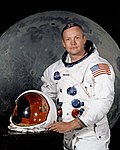 Neil ArmstrongAlso in Footprints on the Moon (1969)
 Lawrence BraggBoth received Maxwell Lecture
 William AndersBoth received Dr. Robert H. Goddard Memorial Trophy
Fame.am measures public visibility signals. It does not measure human value, talent, morality, or credibility.