
The poet who tried to marry avant-garde fury with Bolshevik faith - and found the Soviet state a colder audience than he'd hoped. Mayakovsky roared through Russian Futurism, wrote agitprop for Lenin, then watched censors turn on his satires before he pulled the trigger in 1930.
Also inDeutsch
Photos 8


_18.jpg?width=1200)
_25.jpg?width=1200)


In their own words 10
On the pavementof my trampled soulthe steps of madmenweave the prints of rude crude words.
"1" (1913); translation from Vladimir Mayakovsky. The Bedbug and Selected Poetry. Ed. with introd. by Patricia Blake. Trans. by Max Hayward
Tramp squares with rebellious treading! Up heads! As proud peaks be seen! In the second flood we are spreadingEvery city on earth will be clean.
"Our March" (1917); translation from C. M. Bowra (ed.) A Book of Russian Verse (London: Macmillan, 1943) p. 125
Art must not be concentrated in dead shrines called museums. lt must be spread everywhere - on the streets, in the trams, factories, workshops, and in the workers' homes.
"Shrine or Factory?" (1918); translation from Mikhail Anikst et al. (eds.) Soviet Commercial Design of the Twenties (New York: Abbeville
Awards 2
In their orbit 2

Connected to Vladimir 6


About this person
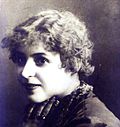
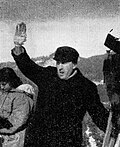
Vladimir Vladimirovich Mayakovsky was born 19 July 1893 and rose in pre-Revolution Russia as a leading voice of Futurism, co-signing the manifesto A Slap in the Face of Public Taste in 1913 and writing poems like A Cloud in Trousers (1915) and Backbone Flute (1916). After 1917 he threw himself into the Bolshevik cause: he directed plays, appeared in films, edited the art journal LEF, and made agitprop posters during the Civil War, his work shot through with admiration for Lenin. But the Soviet state he championed began to chafe - his satirical poem "Talking With the Taxman About Poetry" (1926) and plays The Bedbug (1929) and The Bathhouse (1929) met scorn from censors and the literary establishment as Socialist realism calcified into doctrine. On 14 April 1930, Mayakovsky killed himself. Stalin, whose apparatus had let proletarian writers savage him in life, called him after death "the best and the most talented poet of our Soviet epoch."
Fame.am measures public visibility signals. It does not measure human value, talent, morality, or credibility.