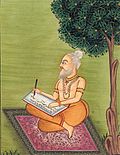
He's called Ādi Kavi - the first poet - because the Ramayana, all 24,000 verses of it, is credited to him. That makes Valmiki the originating voice of Sanskrit epic poetry, the template for storytelling across a subcontinent.
Text from Wikipedia, CC BY-SA 4.0
Also inDeutsch
Photos 8
 Valmiki Ramayana
.jpg?width=1200) 52 Agni, Valmiki, Dasaratha (9125140220)
52 Agni, Valmiki, Dasaratha (9125140220).jpg?width=1200) 54 Valmiki, Rama, Lakshmana (9122910159)
54 Valmiki, Rama, Lakshmana (9122910159).jpg?width=1200) A fowler kills a bird and the cry of its mate gives Valmiki the measures in which he composes the "Ramayana" (cropped)
A fowler kills a bird and the cry of its mate gives Valmiki the measures in which he composes the "Ramayana" (cropped) A fowler kills a bird and the cry of its mate gives Valmiki the measures in which he composes the "Ramayana"
 A statue of Maharishi Valmiki at Hoshiarpur
 Balyogi Umeshnath
_LACMA_AC1999.127.45.jpg?width=1200) Hermitage of Valmiki, Folio from the "Nadaun" Ramayana (Adventures of Rama) LACMA AC1999.127.45
Hermitage of Valmiki, Folio from the "Nadaun" Ramayana (Adventures of Rama) LACMA AC1999.127.45In their own words 10
English translation: You will find no rest for the long years of EternityFor you killed a bird in love and unsuspecting
In: Ramayana translated by William Buck in:Ramayana, Motilal Banarsidass Publ., 1 January 2000, p. 7.
This is truly how I remember the ways of the world. Those words I cursed him with make a verse, and that verse could be sung to music.
In. p. 7.
What a crime! There was not one bit of meat on that little bird. What use is a world run all wrong without a grain of mercy on it?
In. p. 7-8.
Connected to Valmiki 6


About this person
Valmiki was a legendary sage, a maharishi in Hindu tradition, who composed the Ramayana sometime between the 8th century BCE and 3rd century CE - scholars can't pin it closer because the text grew through centuries of additions and edits. The epic spans seven cantos and roughly 480,000 words, telling the story of Prince Rama of Ayodhya, whose wife Sita is abducted by Ravana, the demon-king of Lanka. Some traditions place Valmiki as a contemporary of Rama himself. British satirist Aubrey Menen later noted that Valmiki was recognized as a literary genius partly for his philosophical scepticism and for a narrative choice unusual in ancient literature: he wrote himself into the story, becoming the first author in history to step openly into his own composition.
Text from Wikipedia, CC BY-SA 4.0
Fame.am measures public visibility signals. It does not measure human value, talent, morality, or credibility.