Æthelstan
King of Wessex and first king of England (r. 924-939) · Historical Figures · Lived 895 to 939 · aged 44
Æthelstan is read about 2,809 times a day, in 70 languages.
A typical day, 30 days to 15 October 2026
The middle day of the days counted, so one week of news cannot move it. The line under it is the last 390 days, one point a day.
Something wrong?He took a patchwork of rival kingdoms - Mercian, Viking, Saxon - and for the first time made one England out of it. Æthelstan ruled the whole island by conquest and council, then crushed an invasion at Brunanburh that made his name across Europe.
Also in Deutsch
Photos 11

 Statue in Tamworth, Staffordshire of Æthelflæd, Lady of the Mercians, with her young nephew Æthelstan
 Map of the British Isles in the early tenth century
 Silver penny of King Æthelstan
 A sixteenth-century painting in Beverley Minster in the East Riding of Yorkshire of King Æthelstan with Saint John of Beverley
 Coin of Æthelstan Rex, small cross pattée type, London mint, moneyer Biorneard
 Miniature of St Matthew in the Carolingian gospels presented by Æthelstan to Christ Church Priory, Canterbury; now in the British Library, London
 Alea evangelii, a board game played at Æthelstan's court
In their own words 1
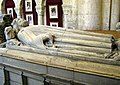 ,
My wish it is that you should always provide the destitute with food.
Family
Parents
 Æthelstan

Brothers and sisters




Is this everyone?
Only relatives with a profile here are drawn, so a family can be larger than this. A line here can also be wrong.
Correct this familyAbout this person
Æthelstan was the son of Edward the Elder and Ecgwynn. When Edward died in July 924, the Mercians accepted Æthelstan as king, but Wessex resisted for months; his half-brother Ælfweard may have been recognised there but died within three weeks. Æthelstan wasn't crowned until September 925. In 927 he conquered York, the last Viking kingdom, becoming the first Anglo-Saxon ruler of all England. He invaded Scotland in 934 and forced Constantine II to submit. The Scots and Vikings resented him, and in 937 they invaded; Æthelstan met them at Brunanburh and won a victory that brought him prestige across the British Isles and the Continent. He centralised government, tightened control over charters, summoned distant leaders and Welsh kings to his councils, and issued more legal texts than any other tenth-century English king - reforms aimed at curbing robbery and building on Alfred the Great's work. His household became the centre of English learning. He never married, had no children, and when he died in October 939 the Vikings took York back.
Historical Figures born in the 890s 6


Fame.am measures public visibility signals. It does not measure human value, talent, morality, or credibility.