Stanisław August Poniatowski
King of Poland and Grand Duke of Lithuania (1764-1795) · Russia · On the map · Politicians · Lived 1732 to 1798 · aged 66
He was the last king Poland ever had - lover of Catherine the Great, patron of Enlightenment reforms, and the man who watched his country vanish from the map in three slow partitions. Whether he was a brave reformer or a hesitant coward is still the argument.
Stanisław August Poniatowski is read about 1,155 times a day, in 57 languages.
A typical day, 30 days to 2 November 2026
The middle day of the days counted, so one week of news cannot move it. The line under it is the last 107 days, one point a day.
Something wrong?People around Stanisław
Family
Parents

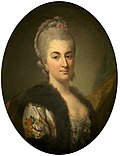
 Stanisław August Poniatowski
Partners

Children


Brothers and sisters


Is this everyone?
Only relatives with a profile here are drawn, so a family can be larger than this. A line here can also be wrong. A marriage is drawn as ended only where its end is recorded, so a spouse drawn here may be a former one.
Correct this familyAlso in Deutsch
Media & music
Photos 12

 Aged 14
 Sir Charles Hanbury Williams, Poniatowski's mentor, by John Giles Eccardt
 Grand Duchess Catherine Alexeyevna, 1745, by Louis Caravaque
 Stanisław August's 1764 election as king, depicted by Bernardo Bellotto
 Tadeusz Rejtan's famous gesture of protest at the Partition Sejm, as depicted by Matejko
 Polish coin bearing the coat of arms of King Stanisław II August, c. 1766
 Portrait by Marcello Bacciarelli, 1786
Awards
About this person
Born into wealthy aristocracy, Stanisław Antoni Poniatowski arrived at the Russian court in 1755 at twenty-two and became intimately involved with the future Catherine the Great. With her backing, he was elected King of Poland and Grand Duke of Lithuania in September 1764. He tried to reform and strengthen the sprawling Commonwealth, but neighboring Prussia, Russia, and Austria wanted it weak, and conservative Polish interests saw his reforms as threats to their ancient privileges. The War of the Bar Confederation led to the First Partition in 1772. His later reforms - the Great Sejm of 1788-1792, the Constitution of 3 May 1791 - were crushed by the Targowica Confederation and the 1792 Polish-Russian War, triggering the Second Partition in 1793, the Kościuszko Uprising in 1794, and the final Third Partition in 1795. He abdicated that November and spent his last years captive in Saint Petersburg's Marble Palace, dying in 1798. Historians credit him as a skillful statesman and a great patron of the arts - the Constitution was an act of bravery - but fault him for not mounting a proper uprising afterward, the failure that sealed Poland's fate.