
Roman Ivanovich Panin
✓ Source-basedrisingSoviet generals (1897-1949)
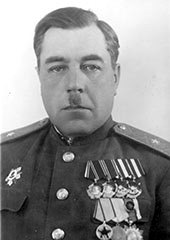
Roman Ivanovich Panin was a Soviet major general during World War II. An Imperial Russian Army junior officer in World War I, he joined the Red Army in 1919. Panin fought in the Russian Civil War and continued to serve after the end of the Russian Civil War.
Photos 1
Awards 7
Connected to Roman 6
 Vasily BadanovAlso won Order of Kutuzov, 2nd classNikanor ZakhvatayevAlso won Order of the Cloud and Banner
 Vladimir ZhdanovAlso won Order of Kutuzov, 2nd class
 Lee Hsi-mingAlso won Order of the Cloud and Banner
 Dmitry RyabyshevAlso won Order of Kutuzov, 2nd class
About this person
Roman Ivanovich Panin was a Soviet major general during World War II. An Imperial Russian Army junior officer in World War I, he joined the Red Army in 1919. Panin fought in the Russian Civil War and continued to serve after the end of the Russian Civil War. He was an advisor to the National Revolutionary Army between 1938 and 1939. Later he participated in the Soviet-Finnish war as a corps commander, and during World War II as the commander of the 14th Army, commanding the defense of Murmansk during Operation Silver Fox. Panin became commander of the 2nd Reserve Army in May 1942 and two months later became a lecturer at the Frunze Military Academy. In February 1943 he became Volkhov Front chief of combat training and in September led the 7th Rifle Corps. After participating in the Leningrad-Novgorod Offensive, Panin briefly led the 99th Rifle Corps. In July 1944, Panin became deputy commander of the 5th Army. Hospitalized in February 1945 during the East Prussian Offensive, Panin did not see further action. After recovering he became an instructor at the Frunze Military Academy and retired in 1949. He died shortly afterwards.
Fame.am measures public visibility signals. It does not measure human value, talent, morality, or credibility.