
Sir Roger L'Estrange was an English pamphleteer, author, courtier and press censor. Throughout his life L'Estrange was frequently mired in controversy and acted as a staunch ideological defender of King Charles II's regime during the Restoration era.
Text from Wikipedia, CC BY-SA 4.0
Also inDeutsch
Photos 3


Writers born in the 1610s 6


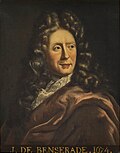

About this person
Sir Roger L'Estrange was an English pamphleteer, author, courtier and press censor. Throughout his life L'Estrange was frequently mired in controversy and acted as a staunch ideological defender of King Charles II's regime during the Restoration era. His works played a key role in the emergence of a distinct 'Tory' bloc during the Exclusion Crisis of 1679-81. Perhaps his best known polemical pamphlet was An Account of the Growth of Knavery, which ruthlessly attacked the parliamentary opposition to Charles II and his successor James, Duke of York, placing them as fanatics who misused contemporary popular anti-Catholic sentiment to attack the Restoration court and the existing social order in order to pursue their own political ends. Following the Exclusion Crisis and the failure of the nascent Whig faction to disinherit James, Duke of York in favour of Charles II's illegitimate son James, 1st Duke of Monmouth, L'Estrange used his newspaper The Observator to harangue his opponents and act as a voice for a popular provincial Toryism during the 'Tory Reaction' of 1681-85. Despite serving as an MP from 1685 to 1689 his stock fell under James II's reign as his staunch hostility to religious nonconformism conflicted with James's goals of religious tolerance for both Catholics and Nonconformists. The Glorious Revolution of 1688 and the collapse of the Restoration political order heralded the end of L'Estrange's career in public life, although his greatest translation work, that of Aesop's Fables, saw publication in 1692.
Text from Wikipedia, CC BY-SA 4.0
Fame.am measures public visibility signals. It does not measure human value, talent, morality, or credibility.