Paul Heyse
German writer (1830-1914) · Writers · Died at 84
Paul Heyse is read about 142 times a day, in 87 languages.
A typical day, 30 days to 15 October 2026
The middle day of the days counted, so one week of news cannot move it. The line under it is the last 390 days, one point a day.
Something wrong?He wrote 177 short stories, sixty dramas, novels, and poetry - and in 1910 the Nobel committee called him Germany's greatest literary talent since Goethe. Today almost no one outside academic circles reads Paul Heyse.
A life in dates
Also in Deutsch
Photos 8
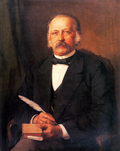
_-_Adolf_Friedrich_Erdmann_von_Menzel_(Museum_Georg_Sch%C3%A4fer).jpg?width=1200) Porträt des Paul Heyse (1853) - Adolf Friedrich Erdmann von Menzel (Museum Georg Schäfer)
Porträt des Paul Heyse (1853) - Adolf Friedrich Erdmann von Menzel (Museum Georg Schäfer) 0582 Lingg Hermann p by Paul Heyse
 Bundesarchiv Bild 183-R21244, München, Adolph von Menzel und Paul Heyse
 Die ehemalige Villa von Paul Heyse in München
_b_533.jpg?width=1200) Die Gartenlaube (1866) b 533
Die Gartenlaube (1866) b 533_b_565.jpg?width=1200) Die Gartenlaube (1867) b 565
Die Gartenlaube (1867) b 565_b_0169.jpg?width=1200) Die Gartenlaube (1896) b 0169
Die Gartenlaube (1896) b 0169Awards
Family
Parents


 Paul Heyse
Partners

Children

Is this everyone?
Only relatives with a profile here are drawn, so a family can be larger than this. A line here can also be wrong.
Correct this familyAbout this person
Born 15 March 1830, Heyse moved through Berlin's Tunnel über der Spree and Munich's Die Krokodile, two literary societies that shaped German letters in his century. Across eight decades he produced an avalanche of work: novels, verse, short fiction, plays. The volume and range made him a dominant figure among German writers, and in 1910 the Nobel Prize arrived "as a tribute to the consummate artistry, permeated with idealism" in his long career. One Nobel judge declared Germany hadn't seen a greater literary genius since Goethe. Heyse died 2 April 1914, the fifth oldest literature laureate on record - and one of the most thoroughly forgotten.




Fame.am measures public visibility signals. It does not measure human value, talent, morality, or credibility.