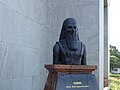
He wrote a grammar so precise that two millennia later it still governs how Sanskrit is taught and spoken. His system of metalinguistic rules became a template for how linguists everywhere think about language structure.
Text from Wikipedia, CC BY-SA 4.0
Also inDeutsch
Photos 7


In their own words 10
Ashtadhyayi Sanskrit treatise on grammar was written in the 6th to 5th century BCE by the Indian grammarian Panini. This work set the linguistic standards for Classical Sanskrit.
Encyclopedia Britannica in: Panini Indian grammarian, britannica.com.
Ashtadhyayi distinguishes between usage in the spoken language and usage that is proper to the language of the sacred texts. The Ashtadhyayi is generative as well as descriptive.
Encyclopedia Britannica in: "Panini Indian grammarian".
The Pāṇinian commentator Kātyāyana (c. 3rd-4th century BCE) knew of the coexistence of Middle Indic forms with earlier ones.
Prof. George Cardona in:"Indo-Aryan languages".
Academics born in the 520s BC 4


About this person
Pāṇini lived in Ancient India sometime between the 6th and 4th centuries BCE - the exact details lost to time, knowable only through what his work reveals. His Ashtadhyayi formally codified Classical Sanskrit, organizing syntax, morphology, and lexicon through a series of meta-rules that treated language as a system. The text is conventionally taken to mark the start of Classical Sanskrit as a refined, standardized language. When European scholars encountered the Ashtadhyayi in the nineteenth century, they recognized something foundational: a descriptive approach to grammar that predated and influenced figures like Ferdinand de Saussure and Leonard Bloomfield. He's been called the father of linguistics, and the claim, for once, isn't overreach.
Text from Wikipedia, CC BY-SA 4.0
Fame.am measures public visibility signals. It does not measure human value, talent, morality, or credibility.