Osamu Dazai is read about 3,612 times a day, in 55 languages.
A typical day, 30 days to 20 October 2026
The middle day of the days counted, so one week of news cannot move it. The line under it is the last 395 days, one point a day.
Something wrong?He wrote about despair with such clarity that readers still can't look away. No Longer Human - his final novel before his 1948 death - became one of the best-selling books in Japanese history, a portrait of alienation so precise it reads like confession.
Also in Deutsch
Photos 8


In their own words 10
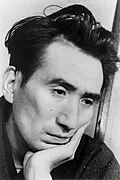 ,
, The weak fear happiness itself. They can harm themselves on cotton wool. Sometimes they are wounded even by happiness.
I have always shook with fright before human beings.
As long as I can make them laugh, it doesn’t matter how, I’ll be alright. If I succeed in that, the human beings probably won’t mind it too much if I remain outside their lives.
Family
 Osamu Dazai
Partners

Children


Is this everyone?
Only relatives with a profile here are drawn, so a family can be larger than this. A line here can also be wrong.
Correct this familyAbout this person
Shūji Tsushima was born in 1909 and took the pen name Osamu Dazai, drawing on Dostoevsky, Akutagawa, and Murasaki Shikibu to shape a voice steeped in psychological unraveling. The Setting Sun made him a fixture of postwar Japanese literature, but it was No Longer Human - published the year he died - that became his defining work, the one that traveled farthest beyond Japan. He also wrote under the name Shunpei Kuroki for Illusion of the Cliffs. He drowned in June 1948, six days before his thirty-ninth birthday, leaving behind novels that turned self-interrogation into an art form.



Fame.am measures public visibility signals. It does not measure human value, talent, morality, or credibility.