Nikolai Bukharin
Russian revolutionary and politician (1888-1938) · Russia · Politicians · Died at 49
Read more often than usual, most of all on 23 October.
7.9 times the usual readers on 23 October. 13,133 readers on 23 October, against about 1,656 a day before the rise.
Lenin called him the party's "most valuable and major theorist," but that didn't save him. Bukharin rose as Stalin's chief ally, architect of Soviet economic policy, then fell hard when the line shifted - tried for treason in 1938 and shot.
A life in dates
Also in Deutsch
Photos 8


In their own words 10
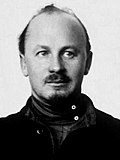 ,
, Fascist ‘order’ is the ‘order’ of military, political and economic barracks; it is the military capitalist system of a state of ‘emergency’.
We see now that infringement of freedom is necessary with regard to the opponents of the revolution.
History moves in contradictions. The skeleton of historic existence, the economic structure of society, also develops in contradictions. Forms eternally follow forms.
In their orbit
About this person
Bukharin joined the Bolsheviks in 1906, studied economics at Moscow Imperial University, got arrested, escaped abroad in 1911, and built his reputation with Lenin and Trotsky through works like Imperialism and World Economy. After the October Revolution he became editor of Pravda and wrote The ABC of Communism during the civil war. He championed the New Economic Policy from 1921 and stood with Stalin against Trotsky, elaborating the theory of "socialism in one country" and serving as General Secretary of the Comintern's executive committee from 1926 to 1929. When Stalin pivoted to forced collectivization, Bukharin became the labeled leader of the Right Opposition and was stripped of his posts in 1929. He returned in 1934 as editor of Izvestia and helped draft the 1936 Soviet Constitution, but the Great Purge caught him: accused of treason in February 1937, he was executed after a show trial the following March.



Fame.am measures public visibility signals. It does not measure human value, talent, morality, or credibility.