Niccolò Machiavelli
Florentine statesman, diplomat, and political theorist (1469-1527) · Politicians · Died at 58
Niccolò Machiavelli is read about 7,115 times a day, in 159 languages.
A typical day, 30 days to 15 October 2026
The middle day of the days counted, so one week of news cannot move it. The line under it is the last 390 days, one point a day.
Something wrong?His name became shorthand for ruthless statecraft - the Florentine who wrote that rulers must be willing to do evil when necessity demands it, turning political philosophy from ideals to cold mechanics.
A life in dates
Also in Deutsch
Photos 11

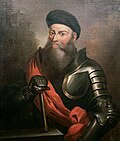
 Oil painting of Machiavelli by Cristofano dell'Altissimo
 Machiavelli's tomb in the Santa Croce Church in Florence
 Lorenzo di Piero de' Medici, to whom the final version of The Prince was dedicated
 Engraved portrait of Machiavelli, from the Peace Palace Library's Il Principe, published in 1769
 Xenophon, author of the Cyropedia
 Statue at the Uffizi
 Francis Bacon argued the case for what would become modern science which would be based more upon real experience and experimentation, free from assumptions about metaphysics, and aimed at increasing control of nature. He named Machiavelli as a predecessor.
In their own words 10
 ,
, Men never do good unless necessity drives them to it; but when they are free to choose and can do just as they please, confusion and disorder become rampant.
So in all human affairs one notices, if one examines them closely, that it is impossible to remove one inconvenience without another emerging.
It was the verdict of ancient writers that men afflict themselves in evil and weary themselves in the good, and that the same effects result from both of these passions.
Family
Parents
Niccolò MachiavelliPartners
Children
Is this everyone?
Only relatives with a profile here are drawn, so a family can be larger than this. A line here can also be wrong.
Correct this familyAbout this person
Niccolò Machiavelli served as secretary to Florence's second chancery from 1498 to 1512, handling diplomatic and military affairs while the Medici were out of power. When the Medici retook Florence in 1512, he was expelled from office, mistakenly suspected of treason, and sent into exile. A year later he turned to writing. Around 1513 he drafted The Prince, a treatise advising that successful rulers must engage in unsavory acts - even killing political enemies - when political necessity requires it, a break from classical thought that made his work controversial from the moment it was published in 1532, five years after his death. His Discourses on Livy, composed around 1517, took a different tack and helped pave the way for modern republicanism, influencing Enlightenment thinkers like Rousseau. Scholars still argue over whether he was describing reality or teaching tyranny.




Fame.am measures public visibility signals. It does not measure human value, talent, morality, or credibility.