Lu Xun is read about 1,638 times a day, in 109 languages.
A typical day, 30 days to 15 October 2026
The middle day of the days counted, so one week of news cannot move it. The line under it is the last 390 days, one point a day.
Something wrong?He turned China's written language inside out. Lu Xun published the first novel in vernacular Chinese - the language people actually spoke - and used it to dissect his country's wounds with a scalpel. The government canonized him. The essays still cut.
Also in Deutsch
Photos 8


In their own words 8
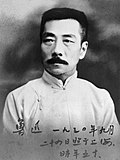 ,
Savage as a lion, timid as a rabbit, crafty as a fox...
When you talk with famous scholars, the best thing is to pretend that occasionally you do not quite understand them.
Hope is like a road in the country; there was never a road, but when many people walk on it, the road comes into existence.
Awards
Family
Lu XunPartners

Brothers and sisters


Is this everyone?
Only relatives with a profile here are drawn, so a family can be larger than this. A line here can also be wrong.
Correct this familyAbout this person
Born Zhou Shuren in 1881 to a declining family of scholar-officials in Shaoxing, he set out to study medicine at Tohoku University in Japan, then abandoned it for literature. Financial trouble pulled him back to China, where he taught and worked a ministry post until 1918, when he published "Diary of a Madman" - the first novel written in vernacular Chinese, not the classical form that had ruled for centuries. The May Fourth Movement in 1919 made him a voice of the New Culture Movement; his essays in La Jeunesse became required reading for a generation trying to remake the country. By the late 1920s he'd moved toward Marxism, and in the 1930s stood as nominal leader of the League of Left-Wing Writers in Shanghai, writing until his death in 1936. Mao Zedong's admiration later cemented his works into the canon of the People's Republic.
Writers from China 6


Fame.am measures public visibility signals. It does not measure human value, talent, morality, or credibility.