Louis I of Hungary
King of Hungary, Poland and Croatia · Hungary · Historical Figures · Lived 1326 to 1382 · aged 56
Louis I of Hungary is read about 565 times a day, in 55 languages.
A typical day, 30 days to 15 October 2026
The middle day of the days counted, so one week of news cannot move it. The line under it is the last 390 days, one point a day.
Something wrong?He ruled over lands touching three seas, forced Venice to surrender Dalmatian cities, and claimed the thrones of Naples and Jerusalem without papal blessing. His campaigns stretched from the Baltic to the Black Sea, but Naples broke him twice and his university in Pécs died within twenty years.
Also in Deutsch
Photos 8
 Louis I (Chronica Hungarorum)
 5. Station, Gedenktafel, Historischer Gedenkweg, 2026 Szarvas
 Banlaky-big hadtortpic 0719
 I. Nagy Lajos király (1342-1382) második kettős felségpecsétjének hátlapja (1366-1382)
 Lands under Louis the Great in the middle of the 14th century
 SS Nagy Lajos Genova Adria Rt. Kircher L II-9
 Nagy lajos
 PalaceHotelInside04
Awards
Family
Parents


 Louis I of Hungary
Partners

Children


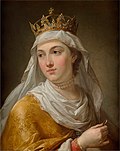
Brothers and sisters


Is this everyone?
Only relatives with a profile here are drawn, so a family can be larger than this. A line here can also be wrong.
Correct this familyAbout this person
Louis inherited Hungary in 1342 at full age with a rich treasury and a mother whose piety shaped his reign. When his brother Andrew was murdered in Naples in 1345, he blamed Queen Joanna I and launched two brutal invasions between 1347 and 1350, adopting Neapolitan titles the pope never recognized; his mercenaries' atrocities made Southern Italy despise him, and he pulled out in 1351. He spent the 1350s reclaiming frontiers against Lithuanians, Serbs, Tatars, and the Golden Horde, bending Venice in 1358 and asserting nominal control over Balkan rulers who resented his Catholic conversion drives. Poland fell to him in 1370 after his uncle Casimir died sonless, but he stayed unpopular there and spent his last years - skin disease eating at him - deepening his faith and backing Charles of Durazzo's seizure of Naples. He died in 1382 with no sons, leaving two daughters and a legend of three-sea dominion that Hungarian chronicles repeated for centuries.


Fame.am measures public visibility signals. It does not measure human value, talent, morality, or credibility.