Louis Armstrong
American jazz musician, trumpeter and singer (1901-1971) · United States · Musicians · Died at 69
Louis Armstrong is read about 3,351 times a day, in 150 languages.
A typical day, 30 days to 15 October 2026
The middle day of the days counted, so one week of news cannot move it. The line under it is the last 390 days, one point a day.
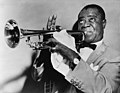
Something wrong?He turned jazz from a group conversation into a solo art - the trumpet player whose gravelly voice on "What a Wonderful World" became as recognizable as his horn, and whose grin opened doors that were supposed to stay closed.
A life in dates
 Louis 'Country & Western' ArmstrongAlbum, 19701968
 Disney Songs the Satchmo WayAlbum1967“The way they're treating my people in the South, the government can go to hell.”In their words19 September 1967As quoted in The New York Times (19 September 1967)]1964“Making money ain't nothing exciting to me. ... You might be able to buy a little better booze than some wino on the corner.”In their wordsNovember 1964Ebony magazine, November 1964
 Hello, Dolly!Album, 19641963
 The Great ReunionAlbum1961Recording Together for the First TimeAlbum1960Star on Hollywood Walk of FameAwardI've Got the World on a StringAlbum1954“The Brick House was one of the toughest joints I ever played in ... Guys would drink and fight one another like circle saws.”In their wordsSatchmo: My Life in New Orleans (1954)1901Born4 August 1901
Also in Deutsch
Photos 8


In their own words 6
 ,
Some of you young folks been saying to me, "Hey Pops, what you mean 'What a wonderful world'? How about all them wars all over the place? You call them wonderful?
The way they're treating my people in the South, the government can go to hell.
Making money ain't nothing exciting to me. ... You might be able to buy a little better booze than some wino on the corner.
Listen
SpotifyOn YouTube
607K subscribersAlbums 24
 PAPops Is Tops: The Verve Studio Albums
 ETElla & Louis (and Oscar Too)
 LMLouis Armstrong - Great Moments 8LDLouis Armstrong na Disney
 SASatchmo
 LFLouis Armstrong and His FriendsLALouis 'Country & Western' Armstrong
 SESatchmo Sings Evergreens
 HDHello, Dolly!
 TRThe Great Reunion
 LDLouie and the Dukes of Dixieland
Awards
In their orbit 2


About this person
Born in New Orleans on August 4, 1901, Armstrong followed his mentor Joe "King" Oliver to Chicago around 1922, joining Oliver's Creole Jazz Band and making his name at cutting contests before Fletcher Henderson brought him to New York. By the 1920s his inventive trumpet work had shifted jazz's center of gravity from collective improvisation to solo performance, and by the 1950s he was everywhere - radio, television, film - a joyful presence who rarely spoke publicly about race but took a stand during the Little Rock Crisis. He recorded with Ella Fitzgerald, appeared in films from Cabin in the Sky to Hello, Dolly!, and won the Grammy for Best Male Vocal Performance in 1965. He died July 6, 1971, having crossed over to white and international audiences at a time when that feat was nearly impossible, his "Melancholy Blues" now drifting past the edge of the solar system on the Voyager Golden Record.


Fame.am measures public visibility signals. It does not measure human value, talent, morality, or credibility.