
Khorloogiin Choibalsan
✓ Source-basedfallingMongolian general and political leader from the 1930s to 1952
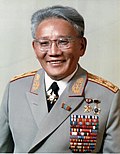
He ran Mongolia as a satellite dictatorship for thirteen years, cementing Soviet control through purges that killed thousands between 1937 and 1939. Choibalsan built a cult of personality and a repressive state apparatus, yet late in his rule he pushed for pan-Mongolian unity - a vision Moscow never shared.
Also inDeutsch
Photos 8


.jpg?width=1200)


Awards 15
In their orbit 1
Connected to Khorloogiin 6
 Yumjaagiin TsedenbalAlso won Badge “Participant in the battles of Khalkhin Gol”
 Pavel SudoplatovAlso won Honorary Officer of the State Security
 Kliment VoroshilovAlso won Medal "For the Victory over Japan" of Mongolia
 Pavel Ivanovich BelyayevAlso won Hero of the Mongolian People's Republic
 Gustáv HusákAlso won Order of Sukhbaatar
 Nikolai BulganinAlso won Medal "For the Victory over Japan"
About this person
Choibalsan was one of the revolutionaries who helped found the Mongolian People's Republic in 1921, then climbed through political and military posts during the 1920s. He briefly led the state as chairman of the Presidium from 1929 to 1930, took command of the army in 1937, and became premier in 1939. From the Ministry of Internal Affairs he directed Stalinist purges that ran until 1939, tightening Mongolia's economic, political, and military dependence on the Soviet Union. After World War II he advocated for unification with Inner Mongolia, a bid that went nowhere. He died of cancer in Moscow in January 1952 and was succeeded by his protégé, Yumjaagiin Tsedenbal.
Fame.am measures public visibility signals. It does not measure human value, talent, morality, or credibility.