Jürgen Habermas is read about 1,669 times a day, in 87 languages.
A typical day, 30 days to 15 October 2026
The middle day of the days counted, so one week of news cannot move it. The line under it is the last 390 days, one point a day.
Something wrong?He built a theory of reason grounded in conversation itself - the idea that rationality doesn't live in lone minds but in the back-and-forth of people talking, arguing, trying to understand each other. That premise reshaped how philosophy thinks about democracy, law, and what the Enlightenment was supposed to deliver.
A life in dates
Also in Deutsch
Photos 8
 JuergenHabermas retouched
 Adorno-Horkheimer
 AdornoHorkheimerHabermasbyJeremyJShapiro2
 Axel Honneth, Thomas McCarthy, Claus Offe, Albrecht Wellmer, Zwischenbetrachtungen 1989
 Bernard Willms, Kritik und Politik 1973
 Concepção de Esfera Pública desenvolvido por Jürgen Habermas
 Gábor Kiss, Paradigmawechsel in der Kritischen Theorie 1987
 Harry Kunneman, Der Wahrheitstrichter 1991
In their own words 9
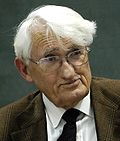 ,
, Christianity has functioned for the normative self-understanding of modernity as more than a mere precursor or a catalyst.
As historical and social beings we find ourselves always already in a linguistically structured lifeworld.
The task of universal pragmatics is to identify and reconstruct universal conditions of possible mutual understanding.
Awards
Family
Jürgen HabermasPartners
Children

Is this everyone?
Only relatives with a profile here are drawn, so a family can be larger than this. A line here can also be wrong.
Correct this familyAbout this person
Habermas came up through the Frankfurt School and spent a career asking whether modernity could still make good on its promise of reason and emancipation. In 1962 he traced the rise and fall of the bourgeois public sphere - the coffeehouses and salons where private people once debated as equals. Two decades later, in *The Theory of Communicative Action*, he argued that real rationality happens between people, in language, not in the instrumental logic of markets or bureaucracies. He held chairs at Heidelberg and Frankfurt, ran the Max Planck Institute in Starnberg, and waded into German political life - most sharply in 1986, when he accused conservative historians of downplaying the Holocaust. Late in life he pushed for European integration and sat down with Cardinal Ratzinger to hash out religion's place in secular democracy. He died in March 2026, still insisting the Enlightenment wasn't finished, only interrupted.
In common with Jürgen
 Daniel Cohn-BenditAlso in Aktiver Streik (1969)
 Karl PopperBoth received Benjamin E. Lippincott Award
 Hans-Georg GadamerBoth received Karl Jaspers Prize
 Julia KristevaBoth received Holberg International Memorial Prize
 Isaiah BerlinBoth received Benjamin E. Lippincott Award
 Nikolaus BlomeBoth received The Franco-German Prize for Journalism
Fame.am measures public visibility signals. It does not measure human value, talent, morality, or credibility.