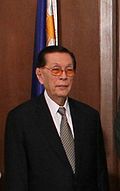
Juan Ponce Enrile
✓ Source-basedfallingFilipino politician, senator and former military chief; Member of the Senate of the Philippines from 1987-1992; 1995-2001; 2004 to 2016
,, also referred to by his initials JPE, was a Filipino politician and lawyer, who served as 26th President of the Senate of the Philippines from 2008 until his resignation in 2013. Enrile was one of the longest-serving Filipino politicians in history, and one of the few to reach the age of 100.
Also inDeutsch
Photos 12

 Enrile's high school graduation in 1948
 Defense Minister Juan Ponce Enrile with President Ferdinand Marcos boarding to a Philippine Airlines Boeing 747-200 Presidential Flight
 "FM Declares Martial Law" - the headline of the September 24, 1972 issue of the Sunday Express, which was the Sunday edition of the Philippines Daily Express. The Daily Express was the only newspaper allowed to circulate upon the declaration of martial law.
 Juan Ponce Enrile's bullet-riddled car
 Defense Secretary Enrile (second from right) and Philippine Ambassador to the U.S. Eduardo Romualdez (center) meeting U.S. President Gerald Ford at the White House in 1976.
 Enrile as a senator, photograph released by the Philippine Congress, c. 1988
 Enrile meets former Cebu Governor Gwen Garcia
On YouTube
8,120 subscribersIn their orbit 2


Connected to Juan 4


Politicians born in the 1920s 2


About this person
Juan Furagganan Ponce Enrile Sr.,, also referred to by his initials JPE, was a Filipino politician and lawyer, who served as 26th President of the Senate of the Philippines from 2008 until his resignation in 2013. Enrile was one of the longest-serving Filipino politicians in history, and one of the few to reach the age of 100. He was known for his role in the administration of Philippine president Ferdinand Marcos; his role in the failed coup that helped hasten the 1986 People Power Revolution and the ouster of Marcos; and his tenure in the Philippine legislature in the years after the revolution. Enrile also participated in rallies supporting ousted president Joseph Estrada in April 2001 that preceded the May 1 riots near Malacañang Palace. Enrile served four terms in the Senate, in a total of twenty-two years and three-hundred twenty days, one of the longest-tenures in the history of the upper chamber. In 2022, at the age of 98, he returned to government office as the Chief Presidential Legal Counsel in the administration of President Bongbong Marcos, serving until his death in 2025.
Fame.am measures public visibility signals. It does not measure human value, talent, morality, or credibility.