John Ruskin
English writer and art critic (1819-1900) · United Kingdom · Writers · Died at 80
John Ruskin is read about 1,263 times a day, in 72 languages.
A typical day, 30 days to 22 October 2026
The middle day of the days counted, so one week of news cannot move it. The line under it is the last 397 days, one point a day.
Something wrong?He preached "truth to nature" and convinced Victorian England to see art as moral witness. A century before environmentalism had a name, Ruskin was already drawing the line from landscape to conscience.
A life in dates
Also in Deutsch
Photos 8
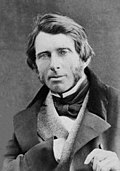
 John Ruskin 1863
 Aberfeldy House, John Ruskin Street - geograph.org.uk - 179436
 Bust of John Ruskin in the North Aisle of the Holy Trinity Church, Sloane Square
 Cover of "Ruskin on Himself and Things in General"
 Edward Elgar - Last page of Gerontius score with quotation
 Hallway through Helmore Building, Anglia Ruskin, 27 Sep, 2012
 Isabella Jays copy after Turner, Petworth Park Tillington Church in the Distance
_-_Glen_Tilt_-_1996P0920_-_Brantwood.jpg?width=1200) John Ruskin (1819-1900) - Glen Tilt - 1996P0920 - Brantwood
John Ruskin (1819-1900) - Glen Tilt - 1996P0920 - BrantwoodIn their own words 10
 ,
, There is really no such thing as bad weather, only different kinds of good weather.
My entire delight was in observing without being myself noticed, - if I could have been invisible, all the better.
Great nations write their autobiographies in three manuscripts - the book of their deeds, the book of their words, and the book of their art.
Awards
Family
Parents

 John Ruskin
Partners

Is this everyone?
Only relatives with a profile here are drawn, so a family can be larger than this. A line here can also be wrong.
Correct this familyAbout this person
John Ruskin was born 8 February 1819 and spent his early career defending J. M. W. Turner in Modern Painters (1843), arguing that an artist's first duty was fidelity to the natural world - art rooted in close observation, not convention. Through the 1850s he championed the Pre-Raphaelites and wrote in an ornate style that eventually gave way to plainer prose as his focus widened. By 1860 he had turned from aesthetics to political economy; Unto This Last marked the pivot toward social reform. In 1869 he became Oxford's first Slade Professor of Fine Art and founded the Ruskin School of Drawing, and two years later began Fors Clavigera, a series of monthly letters to British workers that ran until 1884 and laid out his vision of an ideal society - one that led to the Guild of St George, which survives. He died 20 January 1900, his reputation eclipsed for decades, then restored as the world caught up to his warnings about industry, craft, and what we now call sustainability.
Writers from the United Kingdom 6


Fame.am measures public visibility signals. It does not measure human value, talent, morality, or credibility.