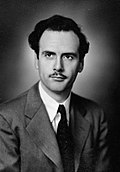
John Kenneth Galbraith
Canadian-American economist and diplomat (1908-2006) · Canada · On the map · Academics · Died at 97
An economist whose books actually sold. Galbraith made the dismal science readable for millions across five decades, then proved you could stabilize an entire wartime economy without letting it explode into inflation - and still have time to write novels and end up on Nixon's enemies list.
John Kenneth Galbraith is read about 456 times a day, in 56 languages.
A typical day, 30 days to 10 November 2026
The middle day of the days counted, so one week of news cannot move it. The line under it is the last 400 days, one point a day.
Something wrong?A life in dates
People around John


 John Kenneth Galbraith
Partners
Children


Is this everyone?
Only relatives with a profile here are drawn, so a family can be larger than this. A line here can also be wrong. A marriage is drawn as ended only where its end is recorded, so a spouse drawn here may be a former one.
Correct this familyMedia & music
Photos 4

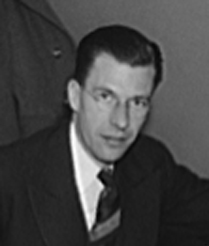 Photograph was taken between 1940 and 1946 "I react pragmatically. Where the market works, I'm for that. Where the government is necessary, I'm for that. I'm deeply suspicious of somebody who says, 'I'm in favor of privatization,' or, 'I'm deeply in favor of public ownership.' I'm in favor of whatever works in the particular case." - C-SPAN, November 13, 1994[17]
 Galbraith at left, as US ambassador to India, with President John F. Kennedy, Vice-President Lyndon B. Johnson, and Prime Minister Jawaharlal Nehru of India, 1961
 Galbraith and First Lady Jacqueline Kennedy at the US Chancery, New Delhi
Awards
About this person
Born October 15, 1908, Galbraith moved from Canada to become the kind of public intellectual America doesn't really make anymore: a Harvard economist for half a century who also ran wartime price controls, served four presidents, and ambassadored to India under Kennedy. He wrote from an institutionalist, post-Keynesian slant and turned out four dozen books - among them the trilogy American Capitalism (1952), The Affluent Society (1958), and The New Industrial State (1967) - plus a thousand articles and several novels, all of it read. His outspokenness in Democratic circles earned him both the World War II Medal of Freedom in 1946 and the Presidential Medal of Freedom in 2000, and a spot on Nixon's master list of political opponents during Watergate. He died April 29, 2006, leaving behind the rare career in which intellectual rigor and popular reach actually converged.
Where to find them
The same award as John
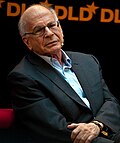 Daniel KahnemanBoth received Leontief Prize for Advancing the Frontiers of Economic Thought
 Angus DeatonBoth received Leontief Prize for Advancing the Frontiers of Economic Thought
 Dani RodrikBoth received Leontief Prize for Advancing the Frontiers of Economic Thought
 Mariana MazzucatoBoth received Leontief Prize for Advancing the Frontiers of Economic Thought