Johannes Brahms is read about 2,273 times a day, in 140 languages.
A typical day, 30 days to 15 October 2026
The middle day of the days counted, so one week of news cannot move it. The line under it is the last 390 days, one point a day.
Something wrong?He kept one foot in Bach's world and the other in his own century, building symphonies and songs that folded old counterpoint into a Romantic frame - and got dragged into a culture war for his trouble.
A life in dates
Also in Deutsch
Photos 8
 JohannesBrahms
 Brahms eerste baldsy van die outograafmanuskrip
 Brahms Tema van derde beweging
 Brahms Tema van eerste beweging van Klavierkonsert no. 1
 Brahms Tema van tweede beweging
 Ilona Eibenschütz Neue Musik-Zeitug 1899, 20. Jg., Nr. 5, S. 58
 Johannes Brahms Anton Sistermans Vier ernste Gesänge Premiere 1896-11-09
 Johannes Brahms Visitenkarte mit Glückwunsch 1896-11-25
In their own words 4
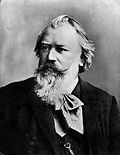 ,
, High on the mountain, deep in the valley, I greet you a thousandfold.
I wish I could write to you as tenderly as I love you and tell you all the good things that I wish you. You are so infinitely dear to me, dearer than I can say...
It always saddens me to think that after all I am not yet a proper musician; but I have more aptitude for the calling than probably many of the younger generation have as a rule.
Listen
SpotifyAlbums 24
 BRBrahms, Chopin, Debussy, Ravel
Awards
Family
Parents
Johannes BrahmsBrothers and sisters
Is this everyone?
Only relatives with a profile here are drawn, so a family can be larger than this. A line here can also be wrong.
Correct this familyAbout this person
Born in Hamburg on 7 May 1833 to a musical family, Brahms toured Central Europe as a young pianist, meeting Franz Liszt in Weimar and eventually winning the backing of Robert and Clara Schumann. He lived with Clara in Düsseldorf during Robert's voluntary commitment and stayed devoted to her after Robert's death, though he never married. Critics cast him as the conservative in the War of the Romantics - a label he resented - while Eduard Hanslick praised his works as absolute music and Hans von Bülow named him heir to Bach and Beethoven, a claim Wagner ridiculed. He led Vienna's Singakademie and Gesellschaft der Musikfreunde, programming early repertoire he studied closely, and kept composing chamber music late in life despite talk of retirement. Arnold Schoenberg later called his structural method "progressive," and the four symphonies, concertos, Requiem, and hundreds of Lieder he left behind anchor the repertoire still.
In common with Johannes



Musicians from Germany 2


Fame.am measures public visibility signals. It does not measure human value, talent, morality, or credibility.