Jacques-Bénigne Bossuet
French bishop and theologian (1627-1704) · France · Religious Figures · Died at 76
Jacques-Bénigne Bossuet is read about 310 times a day, in 41 languages.
Counted to 15 September 2026, not since.
The middle day of the days counted, so one week of news cannot move it. The line under it is the last 60 days, one point a day.
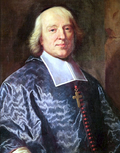
Something wrong?A bishop who turned funeral orations into literature. Bossuet preached absolutism to Louis XIV's court and made the eulogy an art form - his sermons for dead royals are still studied for their prose.
Also in Deutsch
Photos 8
 Jacques-Bénigne Bossuet 1
 A view of universal history Fleuron T114156-2
 Acte de baptême de Bossuet 1627 AD21
 Allegorisch portret van Jacques Bénigne Bosseut, RP-P-1910-5884
 An exposition of the doctrine of the Catholic church in matters of controversie Fleuron T107631-2
 An exposition of the doctrine of the Catholic church, in matters of controversy Fleuron T107632-5
 An exposition of the doctrine of the Catholic church, in matters of controversy Fleuron T107632-6
 An exposition of the doctrine of the Catholic church, in matters of controversy Fleuron T107632-7
In their own words 2
 ,
Il faut aller jusqu'á l'horreur quand on se connaît.
[L]'imagination aide beaucoup l'intelligence.
About this person
Born in Dijon in 1627, Bossuet trained with Jesuits before studying philosophy and theology at the College of Navarre in Paris. Ordained in 1652, he spent seven years at Metz sharpening his command of rhetoric and politics, then returned to Paris where his preaching caught the attention of Louis XIV's court. By the early 1660s he was a fixture at Versailles; in 1670 he became tutor to the Dauphin, joined the Académie Française a year later, and was named Bishop of Meaux in 1681. He championed divine-right monarchy and political absolutism, backed the king's revocation of the Edict of Nantes that stripped Huguenots of their protections, and waded into the theological fights over Gallicanism and Quietism. His funeral orations for Queen Henrietta Maria in 1669, for Henriette Duchess of Orléans in 1670, and for Le Grand Condé in 1687 remain touchstones of French oratory. He died in 1704 at seventy-six.


Fame.am measures public visibility signals. It does not measure human value, talent, morality, or credibility.