Jack the Ripper
Unidentified 19th century serial killer · United Kingdom · Historical Figures
Jack the Ripper is read about 8,928 times a day, in 82 languages.
A typical day, 30 days to 15 October 2026
The middle day of the days counted, so one week of news cannot move it. The line under it is the last 390 days, one point a day.
Something wrong?An unidentified killer who murdered at least five women in London's Whitechapel district in 1888, never caught, never named except by a letter likely forged by journalists. The attention comes from the void where answers should be - and from the brutality that made the crimes impossible to forget.
Also in Deutsch
Photos 12
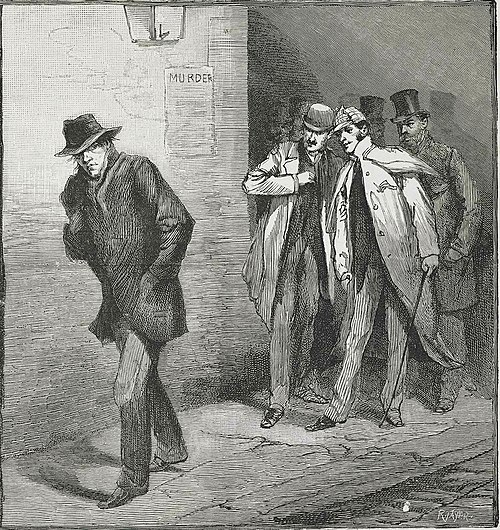
 Women and children congregate in front of one of the Whitechapel common lodging-houses close to where Jack the Ripper murdered two of his victims.[1]
 The sites of the first seven Whitechapel murders - Osborn Street (centre right), George Yard (centre left), Hanbury Street (top), Buck's Row (far right), Berner Street (bottom right), Mitre Square (bottom left), and Dorset Street (middle left)
 29 Hanbury Street. The door through which Annie Chapman and her murderer walked to the yard where her body was discovered is beneath the numerals of the property sign.
 Contemporaneous police drawing of the body of Catherine Eddowes, as discovered in Mitre Square
 Police photograph of the body of Mary Jane Kelly as discovered in 13 Miller's Court, Spitalfields, 9 November 1888
 Frances Coles was found with her throat cut under a railway arch in Whitechapel on 13 February 1891.[94]
 "The Whitehall Mystery" of October 1888
In their own words 1
 ,
Dear Boss, I keep on hearing the police have caught me but they wont fix me just yet. I have laughed when they look so clever and talk about being on the right track.
About this person
In the slums of London's East End between August and November 1888, someone killed women working as prostitutes, cutting their throats and mutilating their bodies with what appeared to be anatomical knowledge. The removal of internal organs from at least three victims suggested surgical skill. As rumours of a connection spread, letters arrived at Scotland Yard and newspapers claiming to be from the murderer - one signed "Jack the Ripper," widely believed a hoax to sell papers; another accompanied by half a human kidney. Police investigated eleven brutal murders in Whitechapel and Spitalfields through 1891 but could not conclusively link them all. Five women - Mary Ann Nichols, Annie Chapman, Elizabeth Stride, Catherine Eddowes, and Mary Jane Kelly - became known as the canonical victims. The murders were never solved, and extensive newspaper coverage turned the case into international legend, a combination of historical research, folklore, and pseudohistory that holds attention still.
Historical Figures from the United Kingdom 6




Fame.am measures public visibility signals. It does not measure human value, talent, morality, or credibility.